The Igbo people are one of Nigeria’s major ethnic groups, with a rich cultural heritage that has been passed from one generation to another for centuries.
Igbo culture is not a single set of customs followed in exactly the same way everywhere. Traditions can differ from one community to another, and practices have also changed over time because of Christianity, Islam, education, urbanisation, migration and other social influences.
Despite these differences, several cultural values and practices remain important in many Igbo communities.
From marriage ceremonies and traditional titles to naming ceremonies, festivals, food, language and respect for elders, Igbo tradition places strong emphasis on family, community and identity.
Below are important things to know about Igbo tradition and culture.
Family Is Very Important
Family occupies an important position in traditional Igbo society.
The extended family system traditionally connects parents, children, grandparents, uncles, aunts and cousins.
Important decisions may involve more than the immediate family because relatives are often expected to support one another during significant events such as marriage, childbirth, funerals and other community occasions.
The concept of umunna, generally referring to a group of people connected through a common male ancestor, is particularly important in many Igbo communities.
Women also maintain strong family connections through their own birth families and maternal relationships.
Respect for Elders
Respect for older people is an important part of Igbo social life.
Children are traditionally taught to greet elders properly, listen when older people are speaking and show respect during community gatherings.
Greetings can also communicate social relationships and respect.
However, respect does not mean that every Igbo community follows exactly the same rules. Customs surrounding greetings, titles and interaction with elders vary between communities.
The Igbo Language
Igbo is the principal indigenous language associated with the Igbo people.
The language has several dialects, meaning that pronunciation and vocabulary can differ considerably between communities.
For many Igbo people, speaking the language is an important part of maintaining cultural identity.
Common Igbo expressions are also used in greetings, prayers, proverbs and everyday conversations.
One well-known expression is “Igwe bu ike,” commonly translated as “There is strength in numbers.”
The importance of proverbs in traditional Igbo communication is also reflected in the saying:
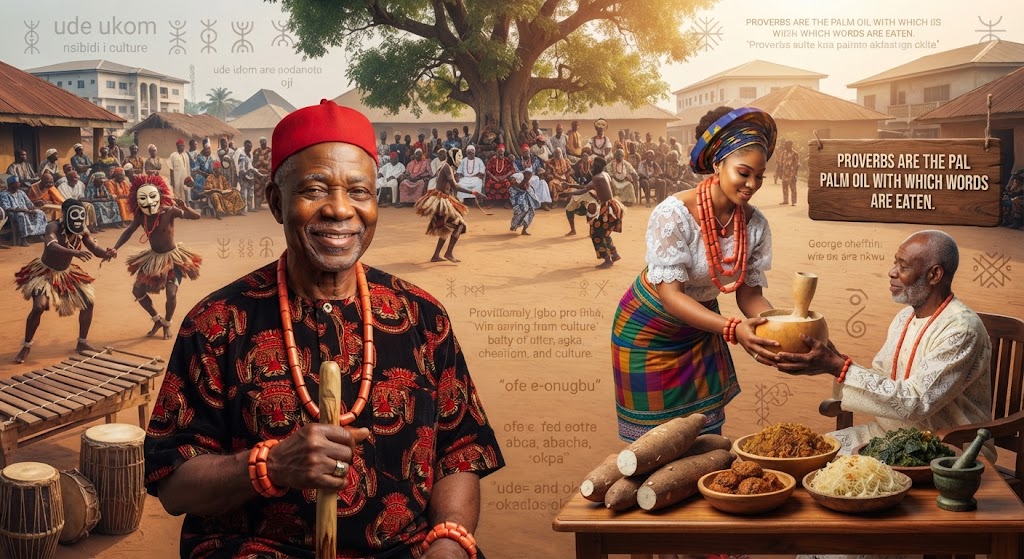
“Proverbs are the palm oil with which words are eaten.”
The saying is commonly associated with Chinua Achebe’s Things Fall Apart and illustrates the importance traditionally attached to wise and carefully expressed speech.
Igbo Proverbs
Proverbs are an important part of traditional Igbo communication.
Elders may use them when giving advice, settling disagreements or explaining a situation.
Rather than speaking directly about every issue, a proverb can communicate an idea in a way that encourages listeners to think about its meaning.
This tradition has also influenced Nigerian literature, particularly works that explore Igbo society and history.
Traditional Igbo Leadership
Traditional Igbo political organisation historically differed from the centralised monarchy found in some other parts of Africa.
Many Igbo communities traditionally operated through village assemblies, councils of elders, titled men and other community institutions.
The Ozo title is one example of an important traditional institution in some Igbo communities.
Modern traditional rulers, often referred to as Igwe, Eze or other titles depending on the community, now occupy important cultural and ceremonial roles in many Igbo areas.
The exact title and responsibilities differ from one community to another.
Igbo Traditional Marriage
Marriage is one of the most important cultural ceremonies in Igbo society.
Traditional marriage may involve several stages, although the exact procedure differs between communities and families.
One important stage is the introduction, where the families of the bride and groom formally meet.
Another important aspect is igba nkwu, commonly known as the wine-carrying ceremony.
During this ceremony, the bride traditionally identifies her husband in front of family members and guests by presenting wine to him.
Marriage negotiations may also involve discussions between both families regarding customary requirements, gifts and other responsibilities.
Today, many Igbo couples combine traditional marriage ceremonies with church weddings or civil marriages.
Bride Price and Marriage Requirements
Traditional Igbo marriage may involve the payment of bride price, often known in Igbo as ime ego isi nwanyi in some communities.
The exact amount and accompanying requirements vary significantly from one community to another.
It is important not to treat every Igbo marriage custom as universal because individual towns and villages can have different practices.
Modern families may also modify traditional requirements because of economic circumstances and changing social expectations.
Naming Ceremonies
The birth of a child is traditionally an important occasion for an Igbo family.
Names may carry meanings connected to family history, circumstances surrounding the child’s birth, gratitude, hopes or religious beliefs.
Some traditional names contain references to God, family experiences or particular events.
Today, many Igbo families give children both indigenous names and English or Christian names.
The naming ceremony can therefore combine traditional family customs with Christian or modern practices.
Traditional Religion
Before the spread of Christianity and other religions, Igbo communities had their own indigenous religious beliefs.
A supreme deity is commonly referred to as Chukwu, while Ala is associated with the earth and moral order in many traditional Igbo belief systems.
Traditional religious practices also involved concepts such as chi, which can refer to an individual’s personal spiritual principle or divine counterpart, although interpretations vary.
Different communities had their own shrines, priests, sacred places and practices.
Christianity is now the dominant religion among most Igbo people, and many traditional religious practices have declined or changed.
New Yam Festival
The New Yam Festival, commonly known as Iri Ji or Iwa Ji, is one of the best-known cultural celebrations among Igbo communities.
Yam has historically been an important crop in Igbo society and has cultural significance beyond its value as food.
The festival traditionally marks the beginning of the new yam harvest.
Communities may organise cultural dances, feasts, ceremonies and other activities.
Traditional rulers and community leaders may also participate.
However, the way the festival is celebrated differs from one community to another.
Masquerades
Igbo masquerades are an important part of traditional festivals and community celebrations.
Different communities have different masquerade traditions, names, costumes and performances.
Masquerades may appear during festivals, funerals, cultural events and other traditional occasions.
Historically, some masquerade institutions were also connected with social and religious functions.
Today, many masquerade performances are primarily cultural displays, although their traditional meanings remain important to particular communities.
Traditional Clothing
Igbo traditional clothing is often worn during weddings, festivals, title ceremonies and other important occasions.
Men may wear outfits such as isi agu, wrappers, shirts, caps and other traditional accessories.
Women may wear wrappers, blouses, head ties, beads and other forms of traditional attire.
Clothing styles can vary depending on the occasion, community and personal preference.
Traditional beads and coral-style accessories are also commonly incorporated into ceremonial dressing.
Igbo Food Culture
Food is an important part of Igbo culture.
Popular foods associated with Igbo communities include ofe onugbu, abacha, ukpaka, okpa, yam, ofe nsala, akpu and various vegetable soups.
Yam has particularly strong cultural importance and is associated with farming, wealth and celebration in many traditional communities.
Food is also central to weddings, festivals, funerals and other gatherings.
The Importance of the Market
Markets have historically played an important economic and social role in Igbo communities.
Trade was not simply about buying and selling goods. Markets also provided opportunities for people to meet, exchange information and build commercial relationships.
The Igbo have also developed a strong reputation for entrepreneurship and trading, both within Nigeria and internationally.
This commercial culture has evolved significantly in the modern era, with Igbo-owned businesses operating across many industries.
Apprenticeship and Mentorship
The Igbo apprenticeship system is one of the most recognised traditional economic institutions associated with the region.
A young person may learn a trade or business from an established entrepreneur through a period of apprenticeship.
Traditionally, the apprentice learns practical skills while working closely with the master.
At the end of the agreed period, the apprentice may receive financial or material support to establish an independent business.
Modern versions of the system continue to exist, although the structure and terms vary widely.
Burial Traditions
Death is treated as an important family and community event in many Igbo communities.
Traditional burial practices can include meetings between family members, funeral ceremonies, prayers, food, music and cultural performances.
However, there is no single Igbo burial ceremony.
Practices differ according to community, religion, family circumstances and social status.
Christian families may combine traditional elements with church funeral services.
Community Meetings and Development
Community associations remain important among many Igbo people.
People from the same town or village may organise development unions to support projects such as roads, schools, electricity, water supply and other community infrastructure.
These organisations can also help settle disputes and coordinate community events.
Many people continue to participate in their hometown associations even when they live far away from their villages.
The Importance of Hard Work
Hard work, independence and economic self-reliance are values frequently emphasised in Igbo families.
Children may be encouraged from an early age to learn a skill, pursue education or develop a means of earning a living.
The traditional importance of farming and trading has also contributed to the strong economic identity associated with many Igbo communities.
However, modern Igbo society is diverse, and people work across virtually every professional field.
Igbo Culture Continues to Change
Igbo tradition is not frozen in the past.
Modern Igbo people continue to adapt their customs to contemporary life.
Social media, migration, education, Christianity, technology and urbanisation have influenced how many traditions are practised.
Some customs have disappeared or become less common, while others have been preserved through cultural festivals, family ceremonies, traditional institutions and community organisations.
This means that what is described as “Igbo tradition” in one community may not necessarily be practised in exactly the same way in another.
Why Igbo Culture Remains Important
Igbo culture provides a connection between generations.
Language, names, proverbs, food, festivals, music, marriage ceremonies and family traditions all help preserve a sense of identity.
At the same time, Igbo communities continue to evolve, with younger generations finding ways to combine traditional values with modern lifestyles.
Understanding Igbo tradition therefore requires looking beyond individual customs and recognising the diversity that exists among Igbo communities.
Igbo culture is rich, diverse and continually evolving. Preserving it does not necessarily mean refusing change; it also means understanding the history and meaning behind the traditions that have shaped generations.