
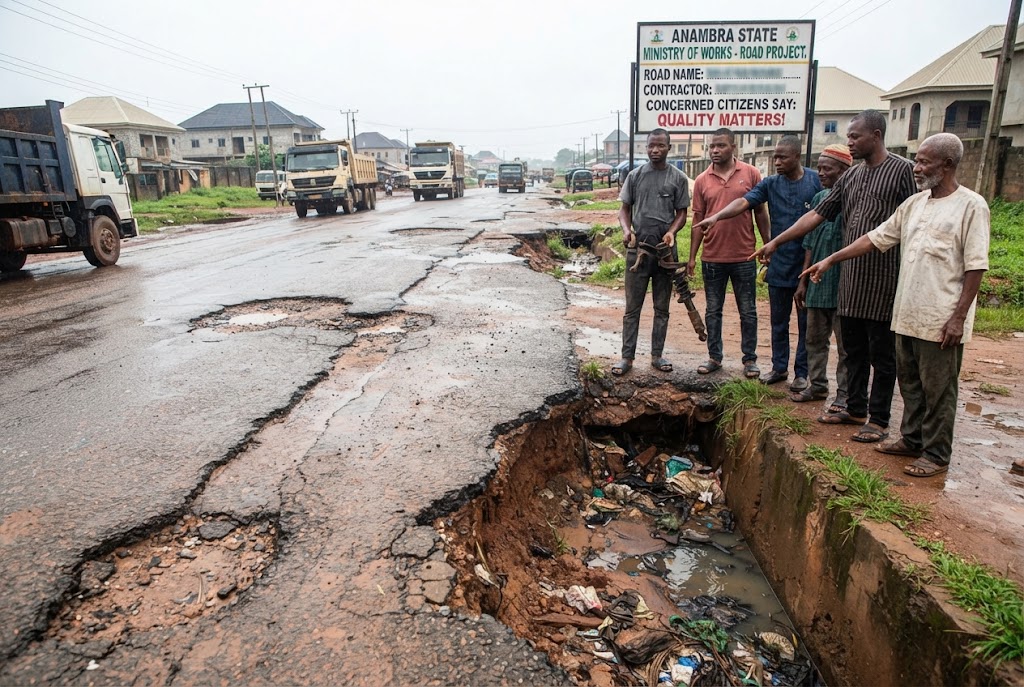
Road construction has become one of the major infrastructure issues attracting public attention in Anambra State, with residents and motorists raising questions about the durability of some roads and the speed at which certain road surfaces develop defects.
For many residents, the concern is not simply about having new roads constructed. They want roads that can withstand heavy traffic, rainfall, erosion and everyday use without requiring frequent repairs.
The debate has also brought attention to the materials used during road construction, drainage systems, road thickness, compaction and the quality of maintenance after a project has been completed.
However, claims that contractors are routinely using inferior materials should not be treated as established facts without project-specific testing or official findings.
Why Are Citizens Concerned About Road Quality?
One reason for the concern is that some newly constructed or recently rehabilitated roads have reportedly developed cracks, potholes, erosion damage or other defects.
In July 2026, the Nigeria Union of Journalists (NUJ), Anambra State Council, expressed concern about the condition of some roads constructed by the state government. The union said some roads had developed defects, while others were undergoing repairs or had been affected by erosion and flooding.
Such reports have generated questions among residents about why roads that are expected to serve communities for many years sometimes require attention relatively soon after construction.
For motorists, the issue is particularly important because poor road surfaces increase vehicle maintenance costs and can make travelling more difficult.
Are Inferior Materials Responsible?
This is one of the biggest questions being asked by members of the public.
When a road develops cracks or begins to deteriorate shortly after construction, people may naturally question the quality of the materials used.
However, road failure can have several causes.
These can include:
Poor-quality or unsuitable construction materials
Inadequate compaction
Insufficient pavement thickness
Poor drainage
Flooding and erosion
Heavy traffic beyond the original design assumptions
Poor construction practices
Weak underlying soil
Inadequate maintenance
Poor workmanship
Water entering the road structure
Therefore, the appearance of cracks or potholes alone does not prove that inferior materials were used.
Determining whether a road was constructed with materials below specification requires proper engineering assessment and laboratory testing.
Anambra Government Introduces Material Testing Requirements
Interestingly, the state government has acknowledged the importance of controlling the quality of materials used for road projects.
In July 2026, the Anambra State Ministry of Works and Infrastructure directed contractors to comply with specific standards for road construction.
The government said the Anambra State Materials Testing Laboratory must take samples of construction materials and certify them before they are used on roads.
The ministry also directed contractors to ensure adequate compaction before laying the stone base.
The Works Commissioner, Okey Ezeobi, also warned contractors that the composition of stone-base materials must meet approved specifications.
According to the ministry, materials containing excessive dust would not meet the required standard.
The government further stressed that the final compacted pavement must achieve the thickness specified in the road design.
Why Material Quality Matters
A road is made up of several layers, and each layer has a role to play.
The underlying soil must be properly prepared before the pavement structure is built.
Materials used for the sub-base and base must meet the required engineering specifications.
Compaction is also important because improperly compacted material can settle after construction.
If the foundation beneath the asphalt is weak, simply placing a fresh layer of asphalt on top may not solve the underlying problem.
This is why road construction requires more than simply spreading asphalt across a surface.
Drainage Is Another Major Issue
Good drainage is particularly important in Anambra because heavy rainfall can create serious pressure on roads.
Water that remains on or underneath a road can weaken the pavement structure over time.
Blocked or inadequate drainage can also contribute to flooding, erosion and the washing away of road materials.
The state government has therefore emphasised drainage and other measures intended to protect roads from water-related damage.
Residents have also raised concerns about wastewater being directed onto roads and the disposal of refuse into drainage channels.
The Anambra State Road Maintenance Agency lists drainage, erosion and flood control among its road-maintenance responsibilities and has urged residents to avoid activities that contribute to road damage.
Rainfall and Flooding Can Affect Roads
Heavy rainfall is another factor that has featured in the debate.
In August 2026, the Anambra Government responded to criticism over roads affected by flooding, arguing that the state had experienced unusually heavy rainfall.
The government said flooding could affect infrastructure even when roads have been properly constructed, while critics continued to question the durability of affected projects.
This difference in explanation is important because a damaged road does not automatically establish whether the primary cause was construction quality, drainage, extreme weather, traffic loading or a combination of factors.
Citizens Want Better Accountability
For many residents, the central issue is accountability.
When public money is spent on road construction, citizens expect the finished project to meet the approved engineering design.
They also want proper supervision throughout the construction process.
This includes checking the materials delivered to the site, monitoring compaction, measuring pavement thickness and ensuring that drainage systems are properly constructed.
The government’s new material-testing requirements appear to address some of these concerns by requiring materials to be tested and certified before use.
What Happens When a Road Fails?
When a road deteriorates, repairs can become another financial burden.
Instead of spending money only once on construction, government may have to allocate additional funds for patching potholes, repairing drainage, resurfacing damaged sections or reconstructing failed portions.
Frequent repairs can therefore raise questions about the original construction and maintenance strategy.
However, maintenance is a normal part of infrastructure management. Even properly constructed roads require regular inspection and maintenance because they are exposed to traffic, weather and environmental conditions.
Road Maintenance Should Not Start Only After Failure
One of the lessons from the ongoing discussion is the importance of preventive maintenance.
Small cracks, blocked drainage channels and minor potholes can become more expensive problems if they are ignored.
Regular inspections can help authorities identify problems before major sections of a road fail.
The Anambra State Road Maintenance Agency says its responsibilities include road repairs and rehabilitation, erosion and flood control, drainage construction and incident response.
Residents Also Have a Role to Play
While government and contractors have major responsibilities, road preservation is not entirely the government’s responsibility.
Residents and businesses can also contribute to the lifespan of roads.
Activities such as dumping refuse into drainage channels, directing wastewater onto roads, damaging road shoulders and carrying out unauthorised activities on road corridors can contribute to deterioration.
The state road maintenance agency has specifically advised residents to practise proper waste disposal and responsible water management.
To address concerns about road durability, several measures can be considered.
1. Stronger Material Testing
Construction materials should be tested before they are incorporated into road projects.
2. Proper Supervision
Engineers should closely monitor contractors from the foundation stage through to asphalt laying.
3. Adequate Compaction
Each pavement layer should be properly compacted according to the approved design.
4. Effective Drainage
Drainage should be treated as an essential part of road construction rather than an afterthought.
5. Regular Maintenance
Roads should be inspected regularly so that minor defects can be corrected before they become major failures.
6. Public Transparency
Where a road develops serious defects, residents deserve clear information about the cause, the contractor’s responsibility and the planned corrective action.
The Bigger Picture
The conversation about Anambra roads goes beyond whether a particular road looks good immediately after construction.
The real test is how the infrastructure performs over time.
Citizens want roads that can withstand normal traffic and environmental conditions, while government has a responsibility to ensure that contractors comply with approved engineering standards.
At the same time, it is important to distinguish between public concerns and proven construction failures.
A road developing defects does not, by itself, prove that substandard materials were used. Proper laboratory testing, engineering inspections and project records are needed to establish the actual cause.
The current debate nevertheless highlights an important issue: road construction and road maintenance must go together.
For Anambra residents, the expectation is straightforward — public roads should be properly designed, constructed according to approved standards, adequately supervised and maintained throughout their useful life.
As more road projects are executed across the state, continued monitoring by government agencies, engineers, communities and other stakeholders will be important in ensuring that infrastructure investment delivers durable results.