
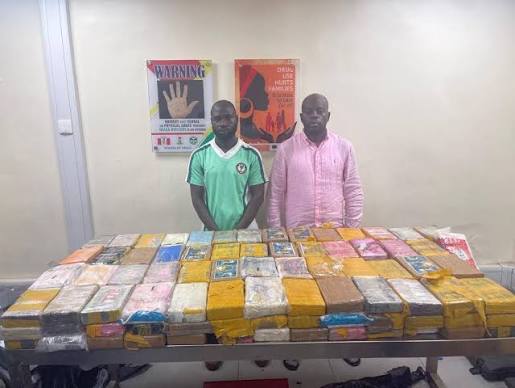
The National Drug Law Enforcement Agency (NDLEA) has arrested a suspected drug cartel leader and social media influencer as he allegedly attempted to flee Nigeria.
The Chairman and Chief Executive Officer of the NDLEA, Brig. Gen. Mohamed Buba Marwa (Rtd.), disclosed this while addressing journalists in Lagos on Tuesday, August 18, 2026.
According to Marwa, the operation began with the interception of a consignment containing 184.50 kilogrammes of cocaine concealed for onward export through a courier logistics channel in Lagos.
Following the seizure, Marwa said he directed the immediate constitution of a Special Investigation Team to trace the network behind the shipment.
The cartel was allegedly hoping to make as much as N39 billion from the consignment through its international distribution network.
Working with the management of the courier company involved, NDLEA operatives uncovered a network of intermediary companies and individuals allegedly used to process the shipment. The investigation led to the arrest of two key suspects, among others.
Marwa identified the first suspect as Lawal Mujab Kehinde, a staff member of the logistics company through which the cocaine was processed.
He said Kehinde was found to have maintained a direct and sustained relationship with the cartel’s Nigerian coordinator.
Investigations, according to the NDLEA boss, also established that Kehinde allegedly packaged and processed consignments for the syndicate and routed them to the United Kingdom, other parts of Europe and Asia in exchange for cash payments.
The second and more prominent suspect is Afolabi Kazeem Michael, popularly known online as “KC Luxury.”
Marwa said investigations identified Afolabi as the alleged Nigerian arrowhead of the cartel.
According to him, Afolabi presented himself publicly as a social media influencer and businessman dealing in gold, jewellery and luxury goods, while allegedly using the image to conceal a criminal enterprise involved in cocaine trafficking.
Marwa said the syndicate allegedly operated a trafficking pipeline from South America through Nigeria to the United Kingdom, other parts of Europe and Asia.
He said Afolabi was arrested on the night of August 13, 2026, after the agency received credible intelligence that he intended to leave the country on a business-class flight to Paris.
“This cartel leader did not walk into our custody voluntarily. On the night of 13th August 2026, upon credible intelligence that he intended to flee the country on a business-class flight to Paris, our operatives moved decisively and apprehended him at the boarding gate of the Murtala Muhammed International Airport, Lagos, just as he attempted to escape the reach of the law.”
According to Marwa, the suspect was found in possession of €7,750, £2,800 and N100,000 in cash, as well as expensive jewellery allegedly linked to the proceeds of his illicit activities.
A subsequent search of his luxury apartment on Banana Island, Ikoyi, Lagos, reportedly led to the recovery of exotic vehicles.
Marwa further disclosed that investigations showed the cartel allegedly used false identities to conceal the true consignors of its shipments and relied on financial facilitators who moved billions of naira on its behalf.
He added that the syndicate maintained criminal contacts in the United Kingdom, some of whom had reportedly been arrested by British authorities in connection with the same investigation.
The NDLEA chairman linked the operation to recent successes recorded against transnational drug trafficking networks, including the dismantling of the Switzerland-based Simon Amadi drug cartel, which allegedly laundered millions of dollars through dark web marketplaces.
He also cited the takedown of two Nigerian-Mexican methamphetamine syndicates operating clandestine laboratories in forests in Ogun and Oyo states.
“These operations send an unmistakable signal that this Agency’s reach extends into the ports, the forests, the luxury apartments, and the departure lounges alike, and that no sanctuary exists anywhere in Nigeria for those who traffic in poison,” Marwa said.
The NDLEA chief said drug trafficking organisations had recently shifted from seaports and airports, where security scrutiny had intensified, to courier and logistics companies, which they allegedly believed offered less-monitored channels for moving narcotics across international borders.
He described the dismantling of the cartel as evidence that the agency has the capacity to track traffickers regardless of where they operate.
“The dismantling of this cartel, from the interception of the consignment at a courier logistics channel right through to the arrest of its Nigerian arrowhead, is a clear demonstration that this Agency has both the capacity and the capability to fish out traffickers wherever they choose to hide, whether in their mansions, forests, enclaves, ports, or behind the counters of courier companies.”
Marwa added:
“Let it be understood: there is no alternative route into or out of Nigeria for illicit drugs that this Agency cannot police.”
He described the operation as a significant example of international cooperation, noting the near-simultaneous arrests of suspected cartel members in Nigeria and the United Kingdom.
Marwa commended the agency’s international partners and members of the Special Investigation Team, coordinated by the Director of Operations and General Investigation, for their professionalism and diligence in uncovering the alleged syndicate.
He warned individuals who attempt to conceal criminal activities behind luxury brands, social media popularity and extravagant lifestyles that the NDLEA would continue to pursue them.
“To those who believe they can hide behind luxury brands, glamorous lifestyles, and social media personas while trafficking poison into our communities and across our borders, this Agency will find you. It does not matter how well-connected, how wealthy, or how far you attempt to run. As this case demonstrates, we will track you to the departure gate if we must,” Marwa said.
He reassured Nigerians of the agency’s continued commitment to protecting communities and preventing the country from being used as a transit route for narcotics destined for other parts of the world.