
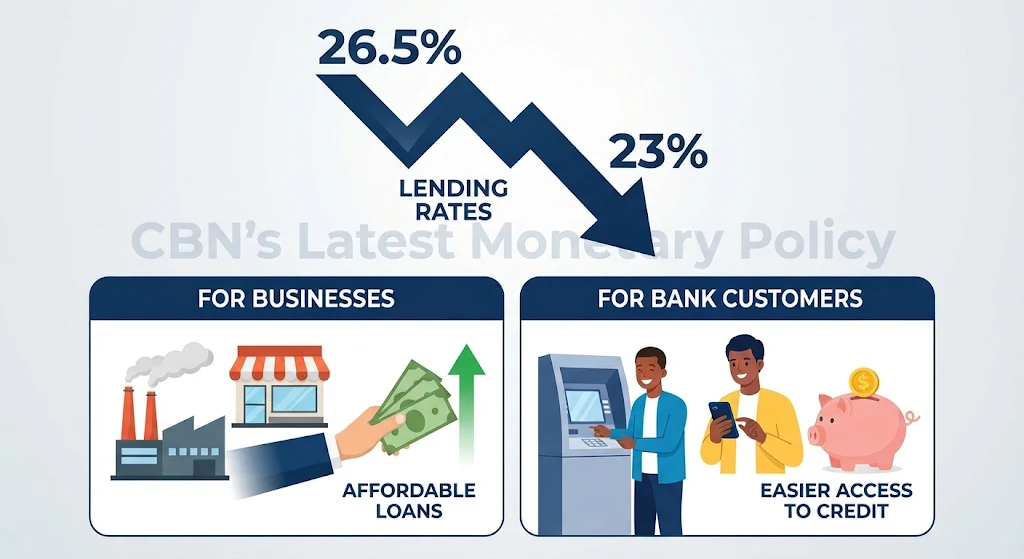
The Central Bank of Nigeria (CBN) has reset its benchmark interest rate to 23 per cent, a development that could have important implications for businesses, investors, borrowers and ordinary Nigerians who use banking services.
The decision followed the 307th meeting of the CBN’s Monetary Policy Committee (MPC), held on September 21 and 22, 2026, where members reviewed developments in the Nigerian economy, inflation trends and other financial conditions.
Before the adjustment, the Monetary Policy Rate (MPR) stood at 26.5 per cent. The latest decision represents a reduction of 3.5 percentage points.
However, the adjustment should not automatically be interpreted as a promise that commercial banks will immediately reduce their lending rates or that Nigerians will begin enjoying cheaper loans.
With the next MPC meeting scheduled for November 23 and 24, attention is already turning to what the committee’s next decision could mean for the economy.
Understanding the CBN’s Monetary Policy Decision
The Monetary Policy Rate is the benchmark interest rate used by the Central Bank to influence borrowing costs, money supply and overall economic activities.
When the CBN increases the rate, borrowing generally becomes more expensive, which can discourage excessive spending and borrowing. The aim is to reduce inflationary pressure.
On the other hand, reducing the rate can create room for lower borrowing costs and encourage investment and economic activities.
However, the relationship is not automatic. Commercial banks consider several factors when determining the interest rates they charge customers.
According to the CBN’s September announcement, the committee also recalibrated the Standing Facilities Corridor to +50/-300 basis points around the MPR.
It retained the Cash Reserve Requirement (CRR) at 45 per cent for deposit money banks, 16 per cent for merchant banks and 75 per cent for non-TSA public sector deposits.
The CBN explained that the adjustment was an operational realignment intended to strengthen monetary policy transmission rather than a change in its underlying monetary policy stance.
What the Decision Means for Nigerian Businesses
For business owners, interest rates are important because they influence the cost of accessing funds for expansion, purchasing equipment, managing inventory and meeting daily operational expenses.
Small and medium-sized enterprises (SMEs), which often depend on bank loans and other financing arrangements, are particularly sensitive to changes in borrowing costs.
A lower benchmark rate could eventually create room for more affordable business financing if commercial banks adjust their lending rates.
For example, an entrepreneur who wants to expand a retail business, purchase machinery or increase production may benefit if borrowing becomes less expensive.
However, business owners should not assume that the reduction in the MPR will immediately translate into cheaper loans.
Banks still consider creditworthiness, operating costs, risks and other market conditions before approving loans and determining interest rates.
Businesses should therefore continue to compare loan offers, understand repayment conditions and avoid borrowing beyond their capacity.
What Bank Customers Should Expect
The CBN’s monetary policy decisions also affect individuals who save, borrow and conduct transactions through commercial banks.
For customers who depend on personal loans, salary advances and other credit facilities, a reduction in the benchmark rate could eventually create room for lower borrowing costs.
However, customers should understand that commercial banks are not required to adjust every loan interest rate immediately following an MPR reduction.
For savers, the situation could be different.
If banks eventually reduce deposit interest rates, customers may earn less from certain savings products and fixed deposits.
This means that the benefits and disadvantages of monetary policy adjustments may not be experienced equally by borrowers and savers.
Customers should pay attention to changes in their banks’ interest rates, account charges and savings product conditions rather than assume that every adjustment by the CBN will automatically affect their accounts.
Will the Decision Reduce the Cost of Living?
One important question Nigerians may have is whether the reduction in the monetary policy rate will translate into cheaper food, transportation, rent and other household expenses.
The answer is not immediate.
Although monetary policy can influence inflation, the prices of goods and services depend on several factors, including transportation costs, exchange rates, energy prices, agricultural production, supply chains and the cost of doing business.
A lower interest rate may support economic activities over time, but it does not automatically mean that market prices will fall.
For ordinary Nigerians already dealing with the cost of living, the real impact will depend on whether broader economic conditions improve and inflation continues to moderate.
Why the Next CBN Meeting Matters
The CBN has scheduled its 308th Monetary Policy Committee meeting for November 23 and 24, 2026.
The meeting is expected to provide another opportunity for policymakers to assess inflation, economic growth, liquidity conditions and developments in the financial market.
Businesses, investors and financial institutions will be watching closely for signals about the direction of monetary policy.
Whether the committee retains the current rate, increases it or makes another adjustment will depend on its assessment of available economic data.
For now, the September decision remains the latest announced monetary policy decision as Nigerians await the outcome of the November meeting.
Monetary policy decisions may appear to be technical financial announcements, but their effects can reach almost every part of the economy.
From the small business owner seeking a loan to the worker saving part of a monthly salary, changes in interest rates can influence important financial decisions.
However, Nigerians should understand that a reduction in the CBN’s benchmark rate does not automatically mean cheaper loans, higher savings returns or lower prices in the market.
The bigger issue is how effectively the policy adjustment translates into improved access to credit, sustainable business growth and better economic conditions.
As the next MPC meeting approaches, attention will remain on the CBN and the decisions that could shape Nigeria’s financial environment in the coming months.