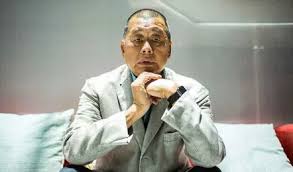
Jimmy Lai, the pro-democracy former Hong Kong media mogul and outspoken critic of Beijing, was convicted on Monday in a landmark national security trial, a verdict that could see him spend the rest of his life in prison.
Three government-vetted judges found Lai, 78, guilty of conspiring to collude with foreign forces to endanger national security and conspiracy to publish seditious articles. He pleaded not guilty to all charges.
Lai was arrested in August 2020 under the Beijing-imposed national security law introduced after massive anti-government protests rocked the city in 2019. He has spent nearly five years in custody, much of it in solitary confinement, and has appeared increasingly frail. He has also previously been convicted of lesser offences related to fraud allegations and his activities during the 2019 protests.
The trial, conducted without a jury, was closely watched by the United States, Britain, the European Union and political observers as a test of media freedom and judicial independence in the former British colony, which returned to Chinese rule in 1997.
Reading from an 855-page verdict, Judge Esther Toh said Lai had extended a “constant invitation” to the United States to help bring down the Chinese government under the pretext of supporting Hong Kong residents. Lai’s lawyers acknowledged during the trial that he had called for sanctions before the national security law took effect but argued he later abandoned those calls to comply with the law.
However, the judges ruled that Lai never wavered in his intention to destabilise the ruling Chinese Communist Party, continuing his efforts “in a less explicit way.” The court said it was satisfied that Lai was the mastermind behind the conspiracies and described his testimony as at times contradictory and unreliable.
The judges concluded that the only reasonable inference from the evidence was that Lai’s intent, both before and after the law came into force, was to seek the downfall of the Communist Party “even at the sacrifice of the people of China and Hong Kong.” “This was the ultimate aim of the conspiracies and secessionist publications,” they wrote.
Lai nodded to his wife and son, who were among those present in court alongside Hong Kong’s Roman Catholic Cardinal Joseph Zen, before being escorted out of the courtroom. The verdict is also seen as a test of Beijing’s diplomatic relations with Western governments.
U.S. President Donald Trump has said he raised the case with China, while U.K. Prime Minister Keir Starmer said securing Lai’s release is a priority for his government. Lai holds British citizenship.
The founder of the now-defunct pro-democracy newspaper Apple Daily will be sentenced at a later date. The collusion charge carries a maximum penalty of life imprisonment. Sentencing hearings are scheduled to begin on January 12, when Lai and his co-defendants will argue for reduced sentences.
Apple Daily, a vocal critic of both the Hong Kong government and Beijing, was forced to shut down in 2021 after police raided its newsroom, arrested senior journalists and froze its assets. During the 156-day trial, prosecutors accused Lai of conspiring with senior executives and others to urge foreign governments to impose sanctions, blockades and other hostile actions against Hong Kong or China.
Prosecutors highlighted Lai’s meetings with former U.S. Vice President Mike Pence and former Secretary of State Mike Pompeo in July 2019 and presented 161 publications, including Apple Daily articles, social media posts and text messages, as evidence.
Lai testified for 52 days in his own defence, insisting he did not call for foreign sanctions after the national security law took effect in June 2020. His legal team argued that his actions were protected under freedom of expression.
As proceedings continued, Lai’s health appeared to deteriorate. His lawyers told the court in August that he suffered from heart palpitations. After the verdict, his lawyer Robert Pang said Lai was in “okay spirits” as the defence team reviewed the ruling.
Before the verdict, Lai’s daughter, Claire, told The Associated Press that her father had grown weaker, losing nails and teeth, and had suffered months of infections, constant back pain, diabetes, heart problems and high blood pressure. “His spirit is strong, but his body is failing,” she said.
Hong Kong authorities said no abnormalities were found during a medical examination following Lai’s complaints of heart problems and insisted that the medical care provided to him was adequate.
Hong Kong leader John Lee said Lai had harmed the fundamental interests of the country, describing his intentions as malicious. Steve Li, chief superintendent of the police National Security Department, dismissed claims of worsening health outside the court, saying, “Lai’s conviction is justice served.”
U.K. Foreign Secretary Yvette Cooper condemned what she described as a politically motivated prosecution and said Britain would continue to call for Lai’s release.
In Beijing, Chinese Foreign Ministry spokesperson Guo Jiakun said China firmly opposed what he called the vilification of Hong Kong’s judiciary by “certain countries,” urging them to respect the city’s legal system.
Rights groups including Reporters Without Borders and Amnesty International criticised the verdict. “It is not an individual who has been on trial — it is press freedom itself, and with this verdict that has been shattered,” said Reporters Without Borders director general Thibaut Bruttin.
Hong Kong’s Secretary for Security, Chris Tang, rejected that claim, saying the verdict had nothing to do with press freedom.
Before dawn on Monday, dozens of residents queued outside the court to secure seats. Former Apple Daily employee Tammy Cheung arrived at 5 a.m., saying she wanted updates on Lai’s health. While she felt the process had been rushed, she added, “I’m relieved that this case can at least conclude soon.”