
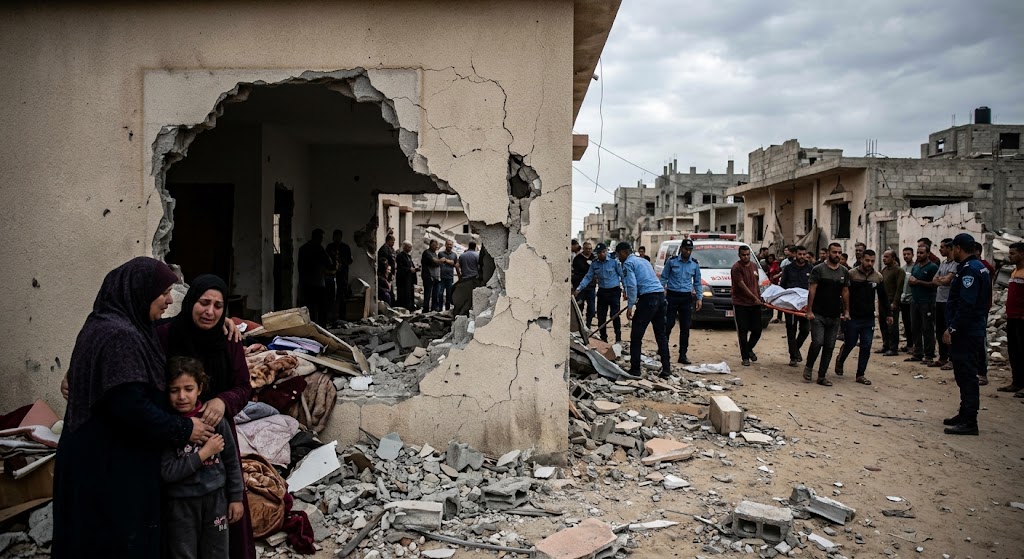
Israeli Strikes Kill Eight People in Gaza as Tensions Rise Despite Ceasefire

Fresh Israeli airstrikes across the Gaza Strip have reportedly killed at least eight Palestinians, including five police officers and a four-year-old child, raising renewed concerns about civilian safety and the fragile ceasefire agreement in the region.

The attacks, which occurred on Sunday, November 1, 2026, targeted separate locations in southern and northern Gaza, according to local medical sources and reports from the Palestinian authorities.

The latest development has drawn attention to the continuing insecurity in Gaza, where thousands of families are still struggling to rebuild their lives after years of conflict, displacement and destruction.

Despite the ceasefire arrangement brokered by the United States in October 2025, violence has continued, leaving residents uncertain about their safety and the possibility of a lasting peace.

What Happened During the Latest Attacks?

According to reports from medical sources, one of the attacks occurred in al-Mawasi, west of Khan Younis in southern Gaza.

Five Palestinian police officers were reportedly killed in an Israeli drone strike while carrying out their duties. Several other people were also wounded during the incident.

Gaza’s Interior Ministry said the officers were performing routine security responsibilities when they were attacked.

However, the Israeli military maintained that its operation targeted militants in the southern part of the territory.

A separate attack was reported in Gaza City’s Rimal neighbourhood, where three Palestinians, including a four-year-old boy, were killed.

The casualties were received at al-Shifa Hospital, according to medical sources.

The deaths have renewed concerns about the risks faced by civilians, particularly children, who continue to live in an environment affected by repeated military operations.

Ceasefire Agreement Faces Fresh Challenges

The latest attacks have raised further questions about the effectiveness of the ceasefire agreement that came into effect in October 2025.

The agreement, which was brokered by the United States, was expected to create an opportunity for reduced hostilities, humanitarian assistance and eventual reconstruction across Gaza.

However, disagreements between the parties have continued to affect its implementation.

Israel has accused Hamas of attempting to rebuild its military capabilities and violating the ceasefire arrangement. Hamas has rejected accusations of rebuilding its arsenal or planning attacks and has accused Israel of undermining the agreement through continued military operations.

Negotiations have also faced difficulties over the proposed disarmament of Hamas and the withdrawal of Israeli forces from Gaza.

These unresolved issues have made it difficult to move towards the next stages of the peace arrangement.

Civilians Continue to Bear the Consequences

Beyond the political and military disagreements, ordinary residents remain among those most affected by the continuing violence.

Gaza’s population has experienced widespread displacement, damaged homes, destroyed infrastructure and limited access to essential services.

Many families are still living in temporary shelters, damaged buildings and makeshift tents after losing their homes during the conflict.

Access to healthcare, clean water, electricity and other basic necessities remains a major concern.

For children, the situation is particularly difficult. Many have experienced repeated displacement, interrupted education and the loss of family members.

The death of a young child in the latest attacks has once again brought attention to the vulnerability of children living in conflict-affected communities.

Humanitarian organisations continue to face the challenge of delivering assistance to people who urgently need food, medical supplies and safe shelter.

Gaza’s Humanitarian Crisis Remains a Global Concern

The humanitarian situation in Gaza remains one of the major international concerns surrounding the Middle East conflict.

According to figures from Gaza’s Ministry of Health, more than 74,000 Palestinians have been killed since the conflict began in October 2023, following the Hamas-led attack on southern Israel on October 7, 2023, which killed approximately 1,200 people.

Gaza health authorities have also reported that more than 1,500 Palestinians have been killed in Israeli attacks since the October 2025 ceasefire came into effect.

These figures illustrate the enormous human cost of the conflict.

The destruction of residential buildings, healthcare facilities, schools and other essential infrastructure has also made recovery increasingly difficult.

Even when active fighting reduces, rebuilding homes, restoring public services and supporting affected families will require substantial resources and international cooperation.

International Attention Turns to the Future of Gaza

The latest developments are likely to increase international calls for renewed diplomatic engagement and stronger efforts to protect civilians.

The United Nations and humanitarian organisations have repeatedly emphasised the importance of protecting civilian lives, ensuring access to humanitarian assistance and respecting international humanitarian law.

A lasting solution will require more than temporary pauses in fighting. It will involve addressing the disagreements preventing the implementation of the ceasefire, establishing security arrangements and creating conditions that allow displaced residents to return to their communities safely.

The international community also faces the challenge of supporting Gaza’s reconstruction while diplomatic efforts continue.

What Happens Next

With fresh attacks being reported despite the ceasefire, uncertainty continues to surround the future of Gaza.

The immediate priority remains the protection of civilians, access to emergency medical care and the delivery of humanitarian assistance.

The international community will also be watching developments surrounding negotiations between the parties, particularly discussions about security arrangements, disarmament and the withdrawal of Israeli forces.

For families living in Gaza, however, the most urgent concern is survival.

Many residents simply want to live without the constant fear of airstrikes, displacement and losing loved ones.

The killing of eight Palestinians in the latest Israeli strikes is another painful reminder that the ceasefire has not brought lasting security to Gaza.

While diplomatic discussions continue, civilians remain exposed to the consequences of unresolved political and military disagreements.

The situation highlights the urgent need for sustained diplomatic efforts, civilian protection and humanitarian support.

A ceasefire should represent an opportunity to save lives and create a path towards lasting peace, not merely a temporary interruption in violence.

For the people of Gaza, peace must eventually become something they can experience in their everyday lives, rather than a promise repeatedly discussed by world leaders.


Julian Daily Gist Editorial Team

Julian Daily Gist Editorial Team is the team responsible for researching, writing, editing, and publishing news and feature content on Julian Daily Gist. Our coverage includes Nigerian current affairs, lifestyle, entertainment, sports, health, business, and human-interest stories. We aim to provide readers with timely, accurate, and responsibly sourced information. The Julian Daily Gist Editorial Team researches, writes, edits, and publishes news and feature content covering Nigerian current affairs, entertainment, sports, health, business, lifestyle, and human-interest stories. We aim to provide accurate, timely, and responsibly sourced information and update our reports when credible new information becomes available. The Julian Daily Gist Editorial Team is responsible for researching, writing, editing, and publishing content across Julian Daily Gist. Our coverage includes Nigerian current affairs, politics, business, entertainment, sports, health, lifestyle, and human-interest stories. We aim to provide readers with timely, accurate, useful, and responsibly sourced information. Our team makes reasonable efforts to verify important information, identify sources, distinguish allegations from confirmed facts, and update reports when credible new information becomes available. We also believe in transparency and accountability. Readers can contact our editorial team to report factual errors, request corrections, or provide additional information relevant to a published story. Editorial focus: News, current affairs, lifestyle, entertainment, sports, health, business, and human-interest stories. Team BIo: The Julian Daily Gist Editorial Team is responsible for researching, writing, editing, and publishing content across Julian Daily Gist. Our coverage includes Nigerian current affairs, politics, business, entertainment, sports, health, lifestyle, and human-interest stories. We aim to provide readers with timely, accurate, useful, and responsibly sourced information. Our team makes reasonable efforts to verify important information, identify sources, distinguish allegations from confirmed facts, and update reports when credible new information becomes available. We also believe in transparency and accountability. Readers can contact our editorial team to report factual errors, request corrections, or provide additional information relevant to a published story. Editorial focus: News, current affairs, lifestyle, entertainment, sports, health, business, and human-interest stories. Editorial Policy: At Julian Daily Gist, our goal is to provide readers with timely, useful, accurate, and responsibly presented news and information. We cover Nigerian current affairs, politics, business, entertainment, sports, health, lifestyle, human-interest stories, and other topics of interest to our readers. 1. Accuracy and Verification We make reasonable efforts to ensure that information published on Julian Daily Gist is accurate and presented in its proper context. Before publishing a report, our editorial team makes reasonable efforts to: - Check information against credible sources. - Verify names, dates, locations, figures, and other important details. - Attribute information to the appropriate source. - Distinguish confirmed facts from allegations, claims, opinions, and speculation. - Update stories when credible new information becomes available. When information cannot be independently verified, we make this clear to readers rather than presenting it as established fact. 2. Sources We use a range of sources, including: - Official government statements. - Police and security agencies. - Courts and legal documents. - Government agencies. - Direct interviews and statements. - Reputable news organizations. - Publicly available records. - Verified social media accounts and statements. When an article relies substantially on information reported by another publication, we aim to clearly attribute the information to that source. We do not intentionally present another publication's reporting as our own. 3. Originality Julian Daily Gist aims to provide original editorial value. When we report information that has already been published elsewhere, we seek to add value through original writing, context, verification, analysis, additional information, or other useful material. We do not intentionally copy and republish articles from other websites without appropriate attribution and meaningful editorial contribution. 4. Allegations and Sensitive Claims When reporting allegations involving individuals or organizations, we make reasonable efforts to clearly identify allegations as allegations. We avoid presenting unproven accusations as established facts. Where relevant, we seek or include responses from the person, organization, or representative concerned. For criminal matters, we recognize that an allegation, arrest, charge, or accusation does not by itself establish guilt. 5. Headlines Our headlines are intended to accurately reflect the content of our articles. We aim to avoid deliberately misleading headlines, fabricated claims, or headlines that exaggerate facts simply to generate clicks. 6. Corrections and Updates We take corrections seriously. If we discover that an article contains a significant factual error, we may correct or update the article as appropriate. Readers who identify an error are encouraged to contact us with specific information supporting the correction. Where appropriate, significant corrections or updates may be noted within the article. 7. Editorial Independence Editorial decisions are made independently of advertisers, sponsors, commercial partners, and other external interests. Advertising or sponsorship does not automatically influence our editorial decisions or the opinions expressed by our writers. 8. Sponsored and Promotional Content Where Julian Daily Gist publishes sponsored, paid, or promotional content, we aim to clearly identify it as such. Sponsored content does not necessarily represent the independent editorial views of Julian Daily Gist. 9. Conflicts of Interest Our editorial team should avoid situations where personal, financial, or other interests could improperly influence reporting. Where a relevant conflict of interest exists, we aim to disclose it when appropriate. 10. Use of Images and Other Media We aim to use images, videos, graphics, and other media responsibly and with appropriate permission, licensing, attribution, or other lawful basis where required. We do not knowingly use copyrighted material in a manner that infringes the rights of its owner. If you believe that material published on Julian Daily Gist infringes your copyright, please contact us so that we can review the matter. 11. Artificial Intelligence We may use technology and artificial intelligence tools to assist with certain editorial tasks, such as research support, proofreading, formatting, transcription, or drafting assistance. However, AI-generated information is not treated as automatically accurate. Content remains subject to human review, editing, fact-checking, and editorial judgment before publication where appropriate. We do not intentionally publish fabricated information generated by AI. 12. Privacy and Personal Information We take reasonable care when handling personal information and avoid publishing unnecessary private information about individuals. Sensitive personal information is published only when there is a legitimate public-interest reason and where appropriate. Our handling of visitor information is explained in our Privacy Policy. 13. Opinion and Commentary Opinion articles and commentary represent the views expressed by the respective writer or contributor. Where appropriate, opinion content will be identified as commentary, analysis, or opinion so that readers can distinguish it from straightforward news reporting. 14. User-Generated Content Comments and other material submitted by readers may be moderated. We reserve the right to remove content that is unlawful, defamatory, abusive, discriminatory, misleading, threatening, spam-related, or otherwise inappropriate. User comments do not necessarily represent the views of Julian Daily Gist. 15. Our Commitment We are committed to improving the quality, accuracy, transparency, and usefulness of Julian Daily Gist. As our publication grows, we will continue reviewing our editorial practices and updating this policy when necessary. 16. Contact and Corrections If you have a correction, clarification, complaint, copyright concern, or question about our editorial practices, please contact us through our Contact Us page.

You May Also Like

Leave a Reply

Your email address will not be published. Required fields are marked *