
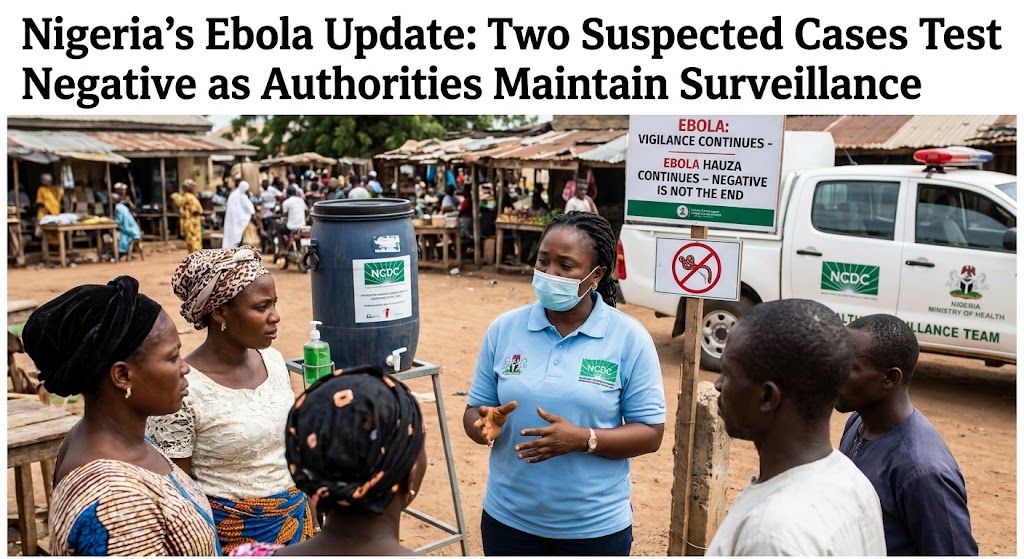
Nigeria’s efforts to prevent the spread of Ebola Virus Disease have received an encouraging development following confirmation that two suspected cases identified in Adamawa State tested negative after laboratory investigations.
The announcement by the Nigeria Centre for Disease Control and Prevention (NCDC) has eased concerns surrounding the possibility of additional infections, particularly following the country’s recent confirmation of an imported Ebola case in the Federal Capital Territory.
According to the NCDC, samples collected from the two individuals in Yola, Adamawa State, returned negative results after two rounds of laboratory testing. The agency also confirmed that there is currently no laboratory-confirmed Ebola case in Adamawa.
However, health authorities have made it clear that the negative results do not mean surveillance efforts should stop. Monitoring, early detection and public awareness remain important parts of Nigeria’s response to the disease.
The development highlights the importance of having a functioning disease surveillance system capable of identifying unusual illnesses before they become larger public health concerns.
How the Suspected Cases Were Identified
The two suspected cases were reported to health authorities in Adamawa following the identification of individuals presenting symptoms that required further medical investigation.
The Adamawa State Public Health Emergency Operations Centre received the report in the early hours of October 30, 2026.
Following the alert, the affected individuals were isolated while samples were collected for laboratory analysis. Public health officials also commenced appropriate response measures, including contact identification and investigation.
The NCDC subsequently confirmed that both individuals tested negative for Ebola after two rounds of testing.
In a statement, the Director-General of the agency, Dr Jide Idris, explained that the NCDC was working closely with the Adamawa State Government through the Ministry of Health and Human Services to investigate the situation and strengthen local response operations.
He commended the state’s health authorities for their prompt intervention, noting that the agency would continue providing technical support.
The outcome means Adamawa currently has no laboratory-confirmed Ebola infection.
Why the Negative Results Matter
Although the two suspected cases tested negative, the development is significant for Nigeria’s public health system.
Ebola is a serious infectious disease that requires early identification, rapid investigation and appropriate infection prevention measures.
When individuals present symptoms associated with the disease, health authorities cannot rely on symptoms alone to establish a diagnosis. Laboratory investigations are necessary to determine whether the infection is present.
The Adamawa incident demonstrates why suspected cases must be investigated promptly rather than ignored or treated as confirmed infections without evidence.
It also highlights the importance of isolating individuals who require investigation while appropriate tests are conducted.
This approach helps protect healthcare workers, other patients and members of the public while medical teams establish the actual cause of an illness.
For Nigeria, the negative results represent an encouraging development, but maintaining preparedness remains necessary.
Nigeria’s Previously Confirmed Ebola Case
The latest development comes against the background of Nigeria’s recent confirmation of an imported Ebola infection.
On October 20, 2026, health authorities confirmed an Ebola case involving a Swiss woman who had travelled from Uganda to Abuja.
The patient tested positive for the Bundibugyo strain of Ebola Virus Disease.
Following confirmation, public health authorities activated response measures, including isolation, medical management, contact tracing and enhanced surveillance.
The patient and her husband were subsequently evacuated to Switzerland on October 26 for further medical care.
According to the NCDC’s November 1 update, the previously confirmed case in the Federal Capital Territory remains Nigeria’s only laboratory-confirmed Ebola case.
This distinction is important because the two suspected cases in Adamawa should not be confused with confirmed infections.
The NCDC has continued working with relevant authorities to monitor the situation and prevent possible transmission.
Understanding Ebola and How It Spreads
Ebola Virus Disease is a severe infectious illness caused by viruses belonging to the Orthoebolavirus genus.
The disease can cause serious illness and may become life-threatening without appropriate medical care.
Transmission occurs through direct contact with the blood, bodily fluids or tissues of an infected person who is symptomatic, or through contaminated materials such as clothing, bedding and medical equipment.
Infection can also occur through contact with infected animals or their bodily fluids.
One important fact Nigerians should understand is that Ebola does not spread through ordinary casual conversation, sitting near an infected person or simply sharing the same air in the way airborne infections such as measles can spread.
The risk is associated primarily with direct exposure to infectious bodily fluids and contaminated materials.
Symptoms may include fever, severe weakness, headache, muscle pain, vomiting, diarrhoea and unexplained bleeding in some cases.
However, these symptoms are not exclusive to Ebola. Other illnesses, including malaria and several other infections, can produce similar symptoms.
This is why proper medical assessment and laboratory testing are essential.
Why Contact Tracing Remains Important
One of the most important strategies in controlling Ebola is contact tracing.
Contact tracing involves identifying individuals who may have been exposed to an infected person and monitoring their health for a specified period.
The process allows health authorities to identify possible infections early and prevent further transmission.
People identified as contacts are not automatically infected with Ebola. Their identification simply means that health officials need to assess their exposure and monitor them appropriately.
The NCDC has previously explained that identified contacts of a confirmed case are generally monitored for 21 days after their last possible exposure.
During this period, health workers may check for symptoms and provide instructions on what to do if an individual becomes unwell.
This process requires cooperation from affected individuals and communities.
Providing accurate information about travel history, contact with suspected patients and the development of symptoms can help health authorities respond more effectively.
What Nigerians Should Do to Protect Themselves
Although the latest results from Adamawa are reassuring, Nigerians should continue practising basic infection prevention measures.
Regular handwashing with soap and running water remains an important preventive measure. Where appropriate, alcohol-based hand sanitisers can also be used.
People should avoid direct contact with the blood and bodily fluids of anyone suspected or confirmed to have Ebola.
Sharing personal items that may be contaminated with bodily fluids should also be avoided.
Anyone who develops symptoms such as fever, severe weakness, headache, muscle pain, vomiting, diarrhoea or unexplained bleeding, particularly after possible exposure to an infected person or relevant travel history, should seek immediate medical attention.
It is important not to engage in self-medication or attempt to manage potentially serious symptoms without professional medical assessment.
Individuals should also provide healthcare workers with accurate information about their recent travel and contact history.
For healthcare professionals, appropriate protective equipment, safe patient handling, proper waste disposal and strict infection prevention and control procedures remain essential.
Hospitals and other healthcare facilities must maintain the ability to recognise, report and safely manage suspected cases.
The Responsibility of Healthcare Facilities
Nigeria’s experience with Ebola has demonstrated that the first point of contact between an infected person and the healthcare system can make a significant difference.
Healthcare workers must remain alert to unusual symptoms, particularly when patients have relevant travel or exposure histories.
A patient presenting with fever should not automatically be assumed to have Ebola. However, where there is a reasonable suspicion based on symptoms and exposure history, appropriate precautions and immediate reporting are necessary.
Healthcare facilities also need functional isolation arrangements, trained personnel and access to reliable laboratory testing.
This is particularly important in areas where healthcare resources are limited.
The responsibility does not rest with the NCDC alone. State ministries of health, hospitals, laboratories, local health workers and community leaders all have important roles to play in disease prevention and response.
Early reporting can make the difference between containing a potential infection and allowing it to go undetected.
Why Public Awareness Is Just as Important as Surveillance
Another challenge during public health emergencies is the spread of misinformation.
Whenever a disease such as Ebola becomes a major topic of discussion, unverified messages, frightening videos and misleading health claims can circulate rapidly on social media.
This can create unnecessary panic and sometimes discourage people from seeking proper medical attention.
The NCDC has urged Nigerians to remain calm and obtain information from official government and public health communication channels.
There is a difference between being informed and being frightened.
People need accurate information about how the disease spreads, its symptoms, preventive measures and the appropriate steps to take when exposure is suspected.
Public awareness should also avoid stigmatising individuals who are being investigated or monitored.
A person identified as a suspected case is not automatically infected, and someone identified as a contact should not be treated as though they have the disease.
Responsible communication is therefore an important part of protecting public health.
What Happens Next?
With the two suspected cases in Adamawa testing negative, attention remains on maintaining surveillance around Nigeria’s previously confirmed imported case.
The NCDC and relevant state health authorities are expected to continue strengthening their monitoring and response activities.
The negative laboratory results are encouraging, but health authorities must continue identifying potential risks, monitoring relevant contacts and ensuring that healthcare facilities remain prepared.
Nigeria’s experience also presents an opportunity to strengthen disease detection beyond Ebola.
A reliable surveillance system should be capable of identifying and responding to different infectious disease threats, including unusual outbreaks that may initially appear to be common illnesses.
Investment in laboratory capacity, healthcare worker training, emergency preparedness and public health communication will remain important.
The Bigger Picture: Prevention Must Not Stop at Negative Results
The latest Ebola update offers Nigerians some reassurance, but it also highlights an important lesson about disease prevention.
A country cannot wait until an outbreak becomes widespread before strengthening its public health response.
Early detection, proper laboratory investigation, contact tracing and public cooperation are among the most important tools for controlling infectious diseases.
The fact that the two suspected cases in Adamawa tested negative after two rounds of testing shows why investigation and confirmation matter before conclusions are drawn.
For ordinary Nigerians, the message is straightforward: remain informed, practise good hygiene, avoid unnecessary panic and seek medical attention when symptoms occur, particularly where there may have been a relevant exposure.
Nigeria’s ability to respond effectively will depend not only on the work of health authorities but also on the willingness of communities to cooperate with public health guidance.
The immediate results from Adamawa are encouraging. However, continued vigilance remains essential to protecting lives and preventing further transmission.