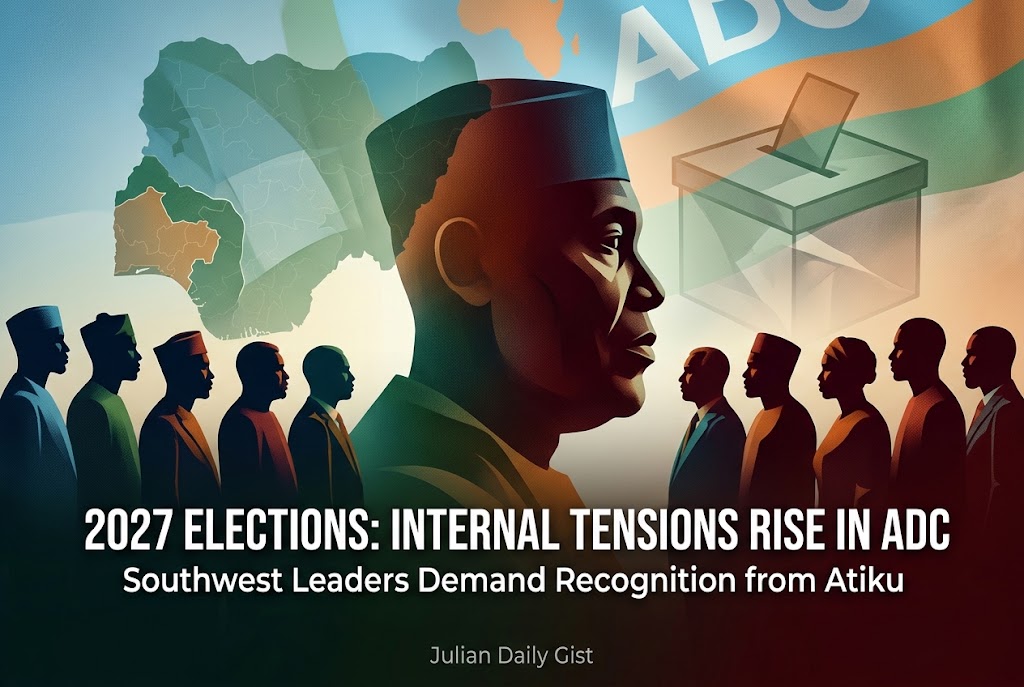
As political activities gradually gather momentum ahead of Nigeria’s 2027 general elections, fresh disagreements have emerged within the African Democratic Congress (ADC), with some party leaders in the Southwest expressing dissatisfaction over how presidential candidate Atiku Abubakar is managing political engagements in the region.
The disagreement goes beyond ordinary party disagreements. At its centre is a question that could become increasingly important as election preparations intensify: how much influence should established party structures have in determining the direction of a presidential campaign?
Several ADC stakeholders, including state chairmen, governorship candidates and other party officials, have reportedly complained that they are not sufficiently involved in political activities associated with Atiku’s presidential ambition. They allege that some of these activities are being coordinated through his personal associates and political allies rather than through the party’s existing structures.
The concerns reportedly came to the forefront during a meeting held in Ibadan, Oyo State, on September 4, where some Southwest governorship candidates and party leaders raised the matter with the party’s National Secretary, Rauf Aregbesola.
According to accounts from participants, the leaders wanted clarity on the relationship between the presidential candidate and the party machinery already operating across the region. Their concern was that members who had invested time and resources in building the party’s structures should not be left outside important political decisions.
The issue reportedly prompted a virtual meeting between Atiku and some Southwest ADC leaders on September 5. During the discussion, Atiku was said to have assured them that their concerns would be addressed and requested that each state submit five names for consideration in his campaign committee.
However, some party insiders claim that the promised changes have not translated into the level of involvement they expected.
The disagreement also appears to involve questions about campaign funding, political recognition and the distribution of responsibilities within the party. Some officials have expressed disappointment over what they described as inadequate financial and organisational support for political activities in the region.
One allegation that has attracted attention concerns a meeting reportedly held in Abuja on September 17, which some Southwest state chairmen attended. An unnamed party official claimed that the officials were unhappy because they did not receive transport assistance after travelling for the engagement.
These allegations have added another dimension to the disagreement, although the party’s regional leadership has challenged the suggestion that presidential candidates should be responsible for every financial obligation of party officials.
For Lagos ADC stakeholders, the concern is particularly about who is representing the party at the grassroots level. Adewole Ijaogbomo, Chairman of ADC Local Government Chairmen in Lagos State, reportedly called on Atiku to address the situation, alleging that a small group of individuals was taking control of political activities while established party leaders were being excluded.
Nevertheless, not everyone within the party agrees that the situation amounts to a leadership problem.
The ADC Southwest Chairman, Akin Omole, confirmed that a meeting took place in Ibadan but explained that its purpose was to discuss strategies for strengthening the party’s presence in the region. He also argued that political candidates should be allowed to maintain relationships with trusted associates outside the formal party structure.
Similarly, Lagos State ADC Chairman George Ashiru dismissed the suggestion that the party was deliberately being sidelined. He explained that the presidential campaign committee had not yet been fully constituted at the state level and argued that party executives should not automatically be expected to occupy positions within campaign management structures.
Atiku’s camp has also rejected the allegations. His Director of Strategic Communication, Phrank Shaibu, described claims that Southwest party executives had been excluded as untrue. He maintained that state campaign coordinators and their respective councils had not yet been formally announced or inaugurated.
Meanwhile, the Osun State chapter of the ADC has dismissed suggestions of a disagreement between Atiku and Aregbesola. The party’s publicity secretary, Oluwaseun Abosede, maintained that political consultations and organisational activities were ongoing, even if they were not always visible to the public.
The unfolding situation is significant because the Southwest occupies an important position in Nigeria’s presidential politics. The region comprises Lagos, Ogun, Oyo, Osun, Ondo and Ekiti, six states with different political interests, influential local structures and established political networks.
The 2023 presidential election demonstrated the region’s divided voting pattern. Bola Tinubu won Ogun, Oyo, Ekiti and Ondo, while Atiku, who contested under the Peoples Democratic Party at the time, secured Osun. Peter Obi of the Labour Party won Lagos.
For the ADC, building an effective political presence across these states will require more than national-level political visibility. It will also involve engaging local stakeholders, maintaining relationships with grassroots organisers and developing a campaign structure that can function across different communities.
The current disagreement therefore raises an important organisational question for the party: can a presidential campaign maintain its independence while also giving established party structures meaningful responsibilities?
As the 2027 elections approach, the ability of political parties to manage internal disagreements will remain an important part of their preparations. For the ADC, resolving concerns about representation, communication and campaign coordination could help determine how effectively its national ambitions connect with its regional structures.
Whether the reported grievances will lead to lasting divisions or result in a more inclusive campaign arrangement remains to be seen. What is clear, however, is that political parties must pay attention not only to their presidential ambitions but also to the people and structures expected to translate those ambitions into support across the country.