
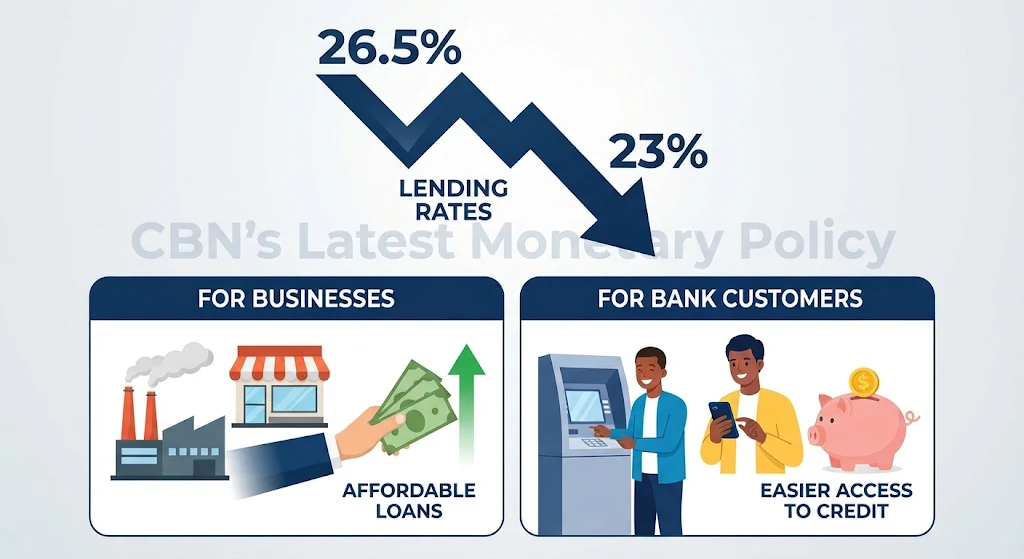
CBN’s Latest Monetary Policy: What It Means for Businesses and Bank Customers

The Central Bank of Nigeria (CBN) has reset its benchmark interest rate to 23 per cent, a development that could have important implications for businesses, investors, borrowers and ordinary Nigerians who use banking services.

The decision followed the 307th meeting of the CBN’s Monetary Policy Committee (MPC), held on September 21 and 22, 2026, where members reviewed developments in the Nigerian economy, inflation trends and other financial conditions.

Before the adjustment, the Monetary Policy Rate (MPR) stood at 26.5 per cent. The latest decision represents a reduction of 3.5 percentage points.

However, the adjustment should not automatically be interpreted as a promise that commercial banks will immediately reduce their lending rates or that Nigerians will begin enjoying cheaper loans.

With the next MPC meeting scheduled for November 23 and 24, attention is already turning to what the committee’s next decision could mean for the economy.

Understanding the CBN’s Monetary Policy Decision

The Monetary Policy Rate is the benchmark interest rate used by the Central Bank to influence borrowing costs, money supply and overall economic activities.

When the CBN increases the rate, borrowing generally becomes more expensive, which can discourage excessive spending and borrowing. The aim is to reduce inflationary pressure.

On the other hand, reducing the rate can create room for lower borrowing costs and encourage investment and economic activities.

However, the relationship is not automatic. Commercial banks consider several factors when determining the interest rates they charge customers.

According to the CBN’s September announcement, the committee also recalibrated the Standing Facilities Corridor to +50/-300 basis points around the MPR.

It retained the Cash Reserve Requirement (CRR) at 45 per cent for deposit money banks, 16 per cent for merchant banks and 75 per cent for non-TSA public sector deposits.

The CBN explained that the adjustment was an operational realignment intended to strengthen monetary policy transmission rather than a change in its underlying monetary policy stance.

What the Decision Means for Nigerian Businesses

For business owners, interest rates are important because they influence the cost of accessing funds for expansion, purchasing equipment, managing inventory and meeting daily operational expenses.

Small and medium-sized enterprises (SMEs), which often depend on bank loans and other financing arrangements, are particularly sensitive to changes in borrowing costs.

A lower benchmark rate could eventually create room for more affordable business financing if commercial banks adjust their lending rates.

For example, an entrepreneur who wants to expand a retail business, purchase machinery or increase production may benefit if borrowing becomes less expensive.

However, business owners should not assume that the reduction in the MPR will immediately translate into cheaper loans.

Banks still consider creditworthiness, operating costs, risks and other market conditions before approving loans and determining interest rates.

Businesses should therefore continue to compare loan offers, understand repayment conditions and avoid borrowing beyond their capacity.

What Bank Customers Should Expect

The CBN’s monetary policy decisions also affect individuals who save, borrow and conduct transactions through commercial banks.

For customers who depend on personal loans, salary advances and other credit facilities, a reduction in the benchmark rate could eventually create room for lower borrowing costs.

However, customers should understand that commercial banks are not required to adjust every loan interest rate immediately following an MPR reduction.

For savers, the situation could be different.

If banks eventually reduce deposit interest rates, customers may earn less from certain savings products and fixed deposits.

This means that the benefits and disadvantages of monetary policy adjustments may not be experienced equally by borrowers and savers.

Customers should pay attention to changes in their banks’ interest rates, account charges and savings product conditions rather than assume that every adjustment by the CBN will automatically affect their accounts.

Will the Decision Reduce the Cost of Living?

One important question Nigerians may have is whether the reduction in the monetary policy rate will translate into cheaper food, transportation, rent and other household expenses.

The answer is not immediate.

Although monetary policy can influence inflation, the prices of goods and services depend on several factors, including transportation costs, exchange rates, energy prices, agricultural production, supply chains and the cost of doing business.

A lower interest rate may support economic activities over time, but it does not automatically mean that market prices will fall.

For ordinary Nigerians already dealing with the cost of living, the real impact will depend on whether broader economic conditions improve and inflation continues to moderate.

Why the Next CBN Meeting Matters

The CBN has scheduled its 308th Monetary Policy Committee meeting for November 23 and 24, 2026.

The meeting is expected to provide another opportunity for policymakers to assess inflation, economic growth, liquidity conditions and developments in the financial market.

Businesses, investors and financial institutions will be watching closely for signals about the direction of monetary policy.

Whether the committee retains the current rate, increases it or makes another adjustment will depend on its assessment of available economic data.

For now, the September decision remains the latest announced monetary policy decision as Nigerians await the outcome of the November meeting.

Monetary policy decisions may appear to be technical financial announcements, but their effects can reach almost every part of the economy.

From the small business owner seeking a loan to the worker saving part of a monthly salary, changes in interest rates can influence important financial decisions.

However, Nigerians should understand that a reduction in the CBN’s benchmark rate does not automatically mean cheaper loans, higher savings returns or lower prices in the market.

The bigger issue is how effectively the policy adjustment translates into improved access to credit, sustainable business growth and better economic conditions.

As the next MPC meeting approaches, attention will remain on the CBN and the decisions that could shape Nigeria’s financial environment in the coming months.

Julian Daily Gist Editorial Team

Julian Daily Gist Editorial Team is the team responsible for researching, writing, editing, and publishing news and feature content on Julian Daily Gist. Our coverage includes Nigerian current affairs, lifestyle, entertainment, sports, health, business, and human-interest stories. We aim to provide readers with timely, accurate, and responsibly sourced information. The Julian Daily Gist Editorial Team researches, writes, edits, and publishes news and feature content covering Nigerian current affairs, entertainment, sports, health, business, lifestyle, and human-interest stories. We aim to provide accurate, timely, and responsibly sourced information and update our reports when credible new information becomes available. The Julian Daily Gist Editorial Team is responsible for researching, writing, editing, and publishing content across Julian Daily Gist. Our coverage includes Nigerian current affairs, politics, business, entertainment, sports, health, lifestyle, and human-interest stories. We aim to provide readers with timely, accurate, useful, and responsibly sourced information. Our team makes reasonable efforts to verify important information, identify sources, distinguish allegations from confirmed facts, and update reports when credible new information becomes available. We also believe in transparency and accountability. Readers can contact our editorial team to report factual errors, request corrections, or provide additional information relevant to a published story. Editorial focus: News, current affairs, lifestyle, entertainment, sports, health, business, and human-interest stories. Team BIo: The Julian Daily Gist Editorial Team is responsible for researching, writing, editing, and publishing content across Julian Daily Gist. Our coverage includes Nigerian current affairs, politics, business, entertainment, sports, health, lifestyle, and human-interest stories. We aim to provide readers with timely, accurate, useful, and responsibly sourced information. Our team makes reasonable efforts to verify important information, identify sources, distinguish allegations from confirmed facts, and update reports when credible new information becomes available. We also believe in transparency and accountability. Readers can contact our editorial team to report factual errors, request corrections, or provide additional information relevant to a published story. Editorial focus: News, current affairs, lifestyle, entertainment, sports, health, business, and human-interest stories. Editorial Policy: At Julian Daily Gist, our goal is to provide readers with timely, useful, accurate, and responsibly presented news and information. We cover Nigerian current affairs, politics, business, entertainment, sports, health, lifestyle, human-interest stories, and other topics of interest to our readers. 1. Accuracy and Verification We make reasonable efforts to ensure that information published on Julian Daily Gist is accurate and presented in its proper context. Before publishing a report, our editorial team makes reasonable efforts to: - Check information against credible sources. - Verify names, dates, locations, figures, and other important details. - Attribute information to the appropriate source. - Distinguish confirmed facts from allegations, claims, opinions, and speculation. - Update stories when credible new information becomes available. When information cannot be independently verified, we make this clear to readers rather than presenting it as established fact. 2. Sources We use a range of sources, including: - Official government statements. - Police and security agencies. - Courts and legal documents. - Government agencies. - Direct interviews and statements. - Reputable news organizations. - Publicly available records. - Verified social media accounts and statements. When an article relies substantially on information reported by another publication, we aim to clearly attribute the information to that source. We do not intentionally present another publication's reporting as our own. 3. Originality Julian Daily Gist aims to provide original editorial value. When we report information that has already been published elsewhere, we seek to add value through original writing, context, verification, analysis, additional information, or other useful material. We do not intentionally copy and republish articles from other websites without appropriate attribution and meaningful editorial contribution. 4. Allegations and Sensitive Claims When reporting allegations involving individuals or organizations, we make reasonable efforts to clearly identify allegations as allegations. We avoid presenting unproven accusations as established facts. Where relevant, we seek or include responses from the person, organization, or representative concerned. For criminal matters, we recognize that an allegation, arrest, charge, or accusation does not by itself establish guilt. 5. Headlines Our headlines are intended to accurately reflect the content of our articles. We aim to avoid deliberately misleading headlines, fabricated claims, or headlines that exaggerate facts simply to generate clicks. 6. Corrections and Updates We take corrections seriously. If we discover that an article contains a significant factual error, we may correct or update the article as appropriate. Readers who identify an error are encouraged to contact us with specific information supporting the correction. Where appropriate, significant corrections or updates may be noted within the article. 7. Editorial Independence Editorial decisions are made independently of advertisers, sponsors, commercial partners, and other external interests. Advertising or sponsorship does not automatically influence our editorial decisions or the opinions expressed by our writers. 8. Sponsored and Promotional Content Where Julian Daily Gist publishes sponsored, paid, or promotional content, we aim to clearly identify it as such. Sponsored content does not necessarily represent the independent editorial views of Julian Daily Gist. 9. Conflicts of Interest Our editorial team should avoid situations where personal, financial, or other interests could improperly influence reporting. Where a relevant conflict of interest exists, we aim to disclose it when appropriate. 10. Use of Images and Other Media We aim to use images, videos, graphics, and other media responsibly and with appropriate permission, licensing, attribution, or other lawful basis where required. We do not knowingly use copyrighted material in a manner that infringes the rights of its owner. If you believe that material published on Julian Daily Gist infringes your copyright, please contact us so that we can review the matter. 11. Artificial Intelligence We may use technology and artificial intelligence tools to assist with certain editorial tasks, such as research support, proofreading, formatting, transcription, or drafting assistance. However, AI-generated information is not treated as automatically accurate. Content remains subject to human review, editing, fact-checking, and editorial judgment before publication where appropriate. We do not intentionally publish fabricated information generated by AI. 12. Privacy and Personal Information We take reasonable care when handling personal information and avoid publishing unnecessary private information about individuals. Sensitive personal information is published only when there is a legitimate public-interest reason and where appropriate. Our handling of visitor information is explained in our Privacy Policy. 13. Opinion and Commentary Opinion articles and commentary represent the views expressed by the respective writer or contributor. Where appropriate, opinion content will be identified as commentary, analysis, or opinion so that readers can distinguish it from straightforward news reporting. 14. User-Generated Content Comments and other material submitted by readers may be moderated. We reserve the right to remove content that is unlawful, defamatory, abusive, discriminatory, misleading, threatening, spam-related, or otherwise inappropriate. User comments do not necessarily represent the views of Julian Daily Gist. 15. Our Commitment We are committed to improving the quality, accuracy, transparency, and usefulness of Julian Daily Gist. As our publication grows, we will continue reviewing our editorial practices and updating this policy when necessary. 16. Contact and Corrections If you have a correction, clarification, complaint, copyright concern, or question about our editorial practices, please contact us through our Contact Us page.

You May Also Like

Leave a Reply

Your email address will not be published. Required fields are marked *