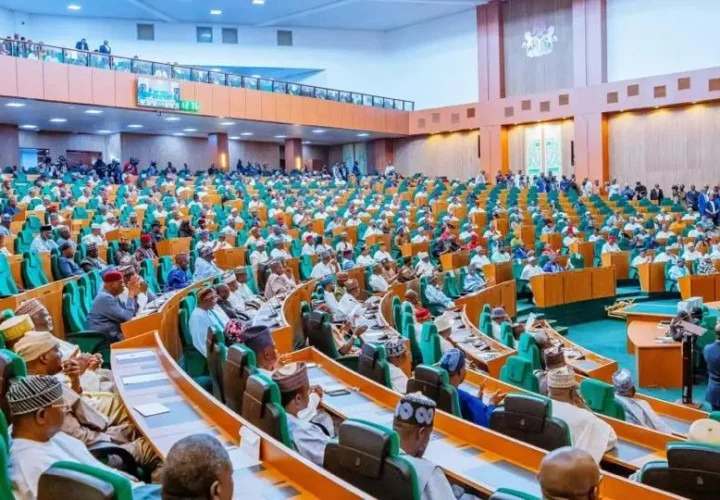
The House of Representatives Minority Caucus Ad-hoc Committee on Tax Laws has confirmed that illegal alterations were made to some of the tax reform laws passed by the National Assembly and signed by President Bola Tinubu. The development has raised serious concerns about legislative integrity and potential constitutional violations.
The committee made this known in its interim report on Friday, January 23, while investigating allegations that discrepancies existed between the versions of tax laws approved by lawmakers and those later published in the official gazette.
The issue first came to public attention after Abdulsamad Dasuki, a member of the House of Representatives, raised concerns during plenary over the circulation of an “authorised” version of the tax laws that differed from what the parliament had passed.
Amid growing public outrage, the Minority Caucus issued a statement on December 28, 2025, vowing to defend the independence of the legislature and Nigeria’s democratic process. The caucus warned that the enforcement of altered or “fake” laws constituted an attack on the constitutional powers of the National Assembly.
To investigate the matter, the Minority Caucus, under the leadership of Kingsley Chinda, constituted a seven-member ad-hoc committee on January 2, 2026. The committee, chaired by Afam Ogene, includes Aliyu Garu (Bauchi), Stanley Adedeji (Oyo), Ibe Osonwa (Abia), Marie Ebikake (Bayelsa), Shehu Fagge (Kano) and Gaza Jonathan (Nasarawa). Its mandate was to establish the facts surrounding the alleged manipulation of the tax laws.
In a statement signed by Ogene, the committee recalled that on January 3, 2026, the House of Representatives, through its spokesman Akintunde Rotimi, announced that Speaker Abbas Tajudeen had directed the public release of the four tax reform Acts signed into law by the president. The Speaker also ordered an internal verification process and the immediate issuance of Certified True Copies (CTCs) to address the controversy and safeguard the credibility of the legislature.
The Acts in question are the Nigeria Tax Act, 2025; Nigeria Tax Administration Act, 2025; National Revenue Service (Establishment) Act, 2025; and Joint Revenue Board (Establishment) Act, 2025. The Clerk to the National Assembly was further directed to collaborate with the Federal Government Printing Press to ensure accuracy and uniformity across all official versions.
According to the committee’s findings, a comparison between the CTCs released by the House and the gazetted versions already in circulation revealed that alterations had indeed been made, with the Nigeria Tax Administration Act, 2025 most affected. The panel noted that three different versions of the Act were in circulation, describing the situation as a procedural anomaly that unlawfully encroached on the constitutional mandate of the National Assembly.
The committee highlighted discrepancies in reporting thresholds under the Act. While the version passed by lawmakers set reporting thresholds at ₦50 million for individuals and ₦100 million for companies, the gazetted version reduced the threshold for individuals to ₦25 million and altered the figures for companies. The panel described the changes as an attempt by the executive to expand the tax net without legislative approval.
It also found that the gazetted version introduced new provisions requiring taxpayers to deposit 20 per cent of disputed tax amounts before appealing decisions of the Tax Appeal Tribunal at the High Court—clauses that were not included in the version passed by the National Assembly. Additional concerns were raised over expanded enforcement powers, including arrests and asset seizures without court orders, as well as amendments to the definition of federal taxes that excluded petroleum income tax and value-added tax (VAT) from federal administration.
On the National Revenue Service (Establishment) Act, the committee reported that clauses empowering the National Assembly to summon officials and demand reports were removed in the gazetted version, weakening parliamentary oversight and the principle of checks and balances. It also cited changes requiring tax computations for petroleum operations to be carried out in US dollars rather than in the currency of transaction approved by lawmakers.
Given the extent of the discrepancies identified, the committee said there was sufficient evidence to justify a deeper investigation. It has therefore requested additional time to conduct a comprehensive probe and ensure accountability for what it described as a serious affront to the legislature and Nigeria’s democratic system.
President Bola Tinubu assented to the four tax reform bills in June 2025. At the time, the presidency stated that the new laws were designed to overhaul tax administration, increase revenue generation, improve the business environment, and attract both local and foreign investment.
Julian Daily Gist Editorial Team
Julian Daily Gist Editorial Team is the team responsible for researching, writing, editing, and publishing news and feature content on Julian Daily Gist. Our coverage includes Nigerian current affairs, lifestyle, entertainment, sports, health, business, and human-interest stories. We aim to provide readers with timely, accurate, and responsibly sourced information.
The Julian Daily Gist Editorial Team researches, writes, edits, and publishes news and feature content covering Nigerian current affairs, entertainment, sports, health, business, lifestyle, and human-interest stories.
We aim to provide accurate, timely, and responsibly sourced information and update our reports when credible new information becomes available.
The Julian Daily Gist Editorial Team is responsible for researching, writing, editing, and publishing content across Julian Daily Gist.
Our coverage includes Nigerian current affairs, politics, business, entertainment, sports, health, lifestyle, and human-interest stories.
We aim to provide readers with timely, accurate, useful, and responsibly sourced information. Our team makes reasonable efforts to verify important information, identify sources, distinguish allegations from confirmed facts, and update reports when credible new information becomes available.
We also believe in transparency and accountability. Readers can contact our editorial team to report factual errors, request corrections, or provide additional information relevant to a published story.
Editorial focus: News, current affairs, lifestyle, entertainment, sports, health, business, and human-interest stories.
Team BIo:
The Julian Daily Gist Editorial Team is responsible for researching, writing, editing, and publishing content across Julian Daily Gist.
Our coverage includes Nigerian current affairs, politics, business, entertainment, sports, health, lifestyle, and human-interest stories.
We aim to provide readers with timely, accurate, useful, and responsibly sourced information. Our team makes reasonable efforts to verify important information, identify sources, distinguish allegations from confirmed facts, and update reports when credible new information becomes available.
We also believe in transparency and accountability. Readers can contact our editorial team to report factual errors, request corrections, or provide additional information relevant to a published story.
Editorial focus: News, current affairs, lifestyle, entertainment, sports, health, business, and human-interest stories.
Editorial Policy:
At Julian Daily Gist, our goal is to provide readers with timely, useful, accurate, and responsibly presented news and information.
We cover Nigerian current affairs, politics, business, entertainment, sports, health, lifestyle, human-interest stories, and other topics of interest to our readers.
1. Accuracy and Verification
We make reasonable efforts to ensure that information published on Julian Daily Gist is accurate and presented in its proper context.
Before publishing a report, our editorial team makes reasonable efforts to:
- Check information against credible sources.
- Verify names, dates, locations, figures, and other important details.
- Attribute information to the appropriate source.
- Distinguish confirmed facts from allegations, claims, opinions, and speculation.
- Update stories when credible new information becomes available.
When information cannot be independently verified, we make this clear to readers rather than presenting it as established fact.
2. Sources
We use a range of sources, including:
- Official government statements.
- Police and security agencies.
- Courts and legal documents.
- Government agencies.
- Direct interviews and statements.
- Reputable news organizations.
- Publicly available records.
- Verified social media accounts and statements.
When an article relies substantially on information reported by another publication, we aim to clearly attribute the information to that source.
We do not intentionally present another publication's reporting as our own.
3. Originality
Julian Daily Gist aims to provide original editorial value.
When we report information that has already been published elsewhere, we seek to add value through original writing, context, verification, analysis, additional information, or other useful material.
We do not intentionally copy and republish articles from other websites without appropriate attribution and meaningful editorial contribution.
4. Allegations and Sensitive Claims
When reporting allegations involving individuals or organizations, we make reasonable efforts to clearly identify allegations as allegations.
We avoid presenting unproven accusations as established facts.
Where relevant, we seek or include responses from the person, organization, or representative concerned.
For criminal matters, we recognize that an allegation, arrest, charge, or accusation does not by itself establish guilt.
5. Headlines
Our headlines are intended to accurately reflect the content of our articles.
We aim to avoid deliberately misleading headlines, fabricated claims, or headlines that exaggerate facts simply to generate clicks.
6. Corrections and Updates
We take corrections seriously.
If we discover that an article contains a significant factual error, we may correct or update the article as appropriate.
Readers who identify an error are encouraged to contact us with specific information supporting the correction.
Where appropriate, significant corrections or updates may be noted within the article.
7. Editorial Independence
Editorial decisions are made independently of advertisers, sponsors, commercial partners, and other external interests.
Advertising or sponsorship does not automatically influence our editorial decisions or the opinions expressed by our writers.
8. Sponsored and Promotional Content
Where Julian Daily Gist publishes sponsored, paid, or promotional content, we aim to clearly identify it as such.
Sponsored content does not necessarily represent the independent editorial views of Julian Daily Gist.
9. Conflicts of Interest
Our editorial team should avoid situations where personal, financial, or other interests could improperly influence reporting.
Where a relevant conflict of interest exists, we aim to disclose it when appropriate.
10. Use of Images and Other Media
We aim to use images, videos, graphics, and other media responsibly and with appropriate permission, licensing, attribution, or other lawful basis where required.
We do not knowingly use copyrighted material in a manner that infringes the rights of its owner.
If you believe that material published on Julian Daily Gist infringes your copyright, please contact us so that we can review the matter.
11. Artificial Intelligence
We may use technology and artificial intelligence tools to assist with certain editorial tasks, such as research support, proofreading, formatting, transcription, or drafting assistance.
However, AI-generated information is not treated as automatically accurate. Content remains subject to human review, editing, fact-checking, and editorial judgment before publication where appropriate.
We do not intentionally publish fabricated information generated by AI.
12. Privacy and Personal Information
We take reasonable care when handling personal information and avoid publishing unnecessary private information about individuals.
Sensitive personal information is published only when there is a legitimate public-interest reason and where appropriate.
Our handling of visitor information is explained in our Privacy Policy.
13. Opinion and Commentary
Opinion articles and commentary represent the views expressed by the respective writer or contributor.
Where appropriate, opinion content will be identified as commentary, analysis, or opinion so that readers can distinguish it from straightforward news reporting.
14. User-Generated Content
Comments and other material submitted by readers may be moderated.
We reserve the right to remove content that is unlawful, defamatory, abusive, discriminatory, misleading, threatening, spam-related, or otherwise inappropriate.
User comments do not necessarily represent the views of Julian Daily Gist.
15. Our Commitment
We are committed to improving the quality, accuracy, transparency, and usefulness of Julian Daily Gist.
As our publication grows, we will continue reviewing our editorial practices and updating this policy when necessary.
16. Contact and Corrections
If you have a correction, clarification, complaint, copyright concern, or question about our editorial practices, please contact us through our Contact Us page.