
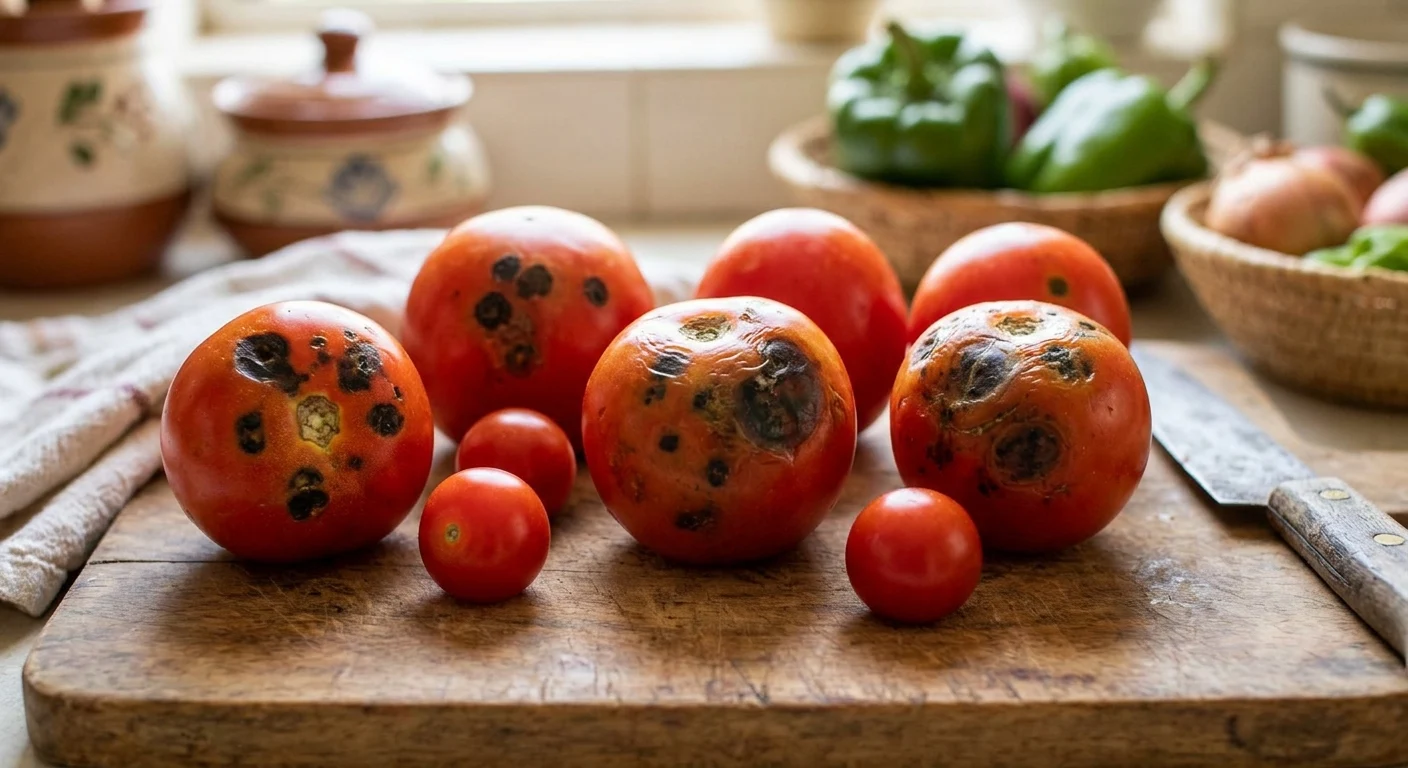
Why You Should Never Cook with Tomatoes That Have Black Spots

Tomatoes are among the most commonly used ingredients in Nigerian kitchens. From preparing jollof rice and stew to making soup and other everyday meals, tomatoes are almost impossible to avoid in many households.

However, one thing many people overlook when preparing tomatoes is the presence of black spots.

You may have bought fresh tomatoes from the market only to discover dark patches, black spots or unusual marks on some of them. Instead of throwing them away, you might simply cut off the affected portion and use the remaining part for cooking.

While this may appear to be a way of avoiding food waste, it is important to understand that some black spots on tomatoes may indicate fungal infection, decay or other forms of deterioration.

Cooking with spoiled tomatoes without properly identifying the cause of the discoloration could expose you and your family to unnecessary food safety risks.

Here is what you should know.

1. Black Spots May Be a Sign of Fungal Growth

Not every black spot on a tomato means it is contaminated with dangerous microorganisms. Some spots result from bruising, insect damage, sunscald or physiological disorders.

However, black, soft, sunken or spreading spots can sometimes indicate fungal infection or rotting.

Certain fungi can cause visible lesions on tomatoes, particularly when the fruits are exposed to moisture, poor storage conditions or physical damage.

In some cases, mould may not be limited to the portion visible on the surface. This is why it is important not to assume that a tomato is safe simply because the affected area appears small.

2. Some Moulds Can Produce Harmful Substances

One important food safety concern associated with mouldy food is the possibility of mycotoxin production.

Certain species of fungi produce substances known as mycotoxins, which can be harmful when consumed in sufficient quantities.

Although not every mould produces mycotoxins, and not every black spot indicates their presence, the risk is one reason visibly mouldy or rotten tomatoes should not be used for cooking.

Another important point is that cooking does not reliably destroy all mycotoxins. Therefore, boiling, frying or blending a spoiled tomato should not be considered a way of making it safe.

3. Washing or Cutting Off the Black Portion May Not Be Enough

A common practice in many households is to wash a tomato thoroughly or remove the visibly affected portion before using the remaining part.

Unfortunately, this approach is not always safe.

When mould is present, its microscopic structures may extend beyond what is visible on the surface. Cutting away a small black patch does not guarantee that the remaining tomato is free from contamination.

Unlike some firm vegetables, tomatoes have a soft, high-moisture structure. For this reason, food safety guidance generally recommends discarding mouldy soft fruits and vegetables rather than attempting to salvage them.

4. Cooking Does Not Automatically Make Spoiled Tomatoes Safe

One dangerous misconception about food preparation is the belief that heat destroys everything harmful in spoiled food.

Although adequate cooking can kill many disease-causing microorganisms, it does not reverse food spoilage or guarantee the destruction of toxins that may already have formed.

This means that adding visibly mouldy tomatoes to boiling stew or allowing them to cook for a long time does not necessarily make them safe for consumption.

When in doubt, throwing away a spoiled tomato is a safer decision than risking the health of everyone who will eat the meal.

5. Spoiled Tomatoes Can Affect the Quality of Your Food

Apart from potential health risks, deteriorating tomatoes can affect the taste, smell and quality of your meals.

Tomatoes that have started rotting may develop unpleasant odours, unusual textures and undesirable flavours.

Using them can compromise the quality of your stew, sauce or soup, even when other ingredients are fresh.

How to Identify Tomatoes That May Be Unsafe to Eat

Before using tomatoes for cooking, take a few seconds to examine them.

Watch out for these warning signs:

Black or dark patches that are soft, sunken or spreading.

Visible fuzzy mould, which may appear white, green, grey or black.

Unpleasant or rotten smell.

Excessively soft, mushy or leaking portions.

Unusual discoloration accompanied by signs of decay.

Skin that has broken down and become slimy.

Remember that a small, dry surface mark or natural colour variation does not automatically mean a tomato is spoiled. The texture, smell and appearance should all be considered.

What Should You Do If You Find Black Spots on Your Tomatoes?

The safest approach depends on what caused the discoloration.

If the tomato has visible mould, soft rot or signs of spoilage, discard the entire fruit. Do not simply cut away the affected portion and cook with the remainder.

If the mark is a dry, superficial blemish and the tomato remains firm, fresh-smelling and otherwise normal, it may simply be a cosmetic defect rather than spoilage.

When you cannot confidently determine the cause, it is safer to discard it.

Five Ways to Keep Your Tomatoes Fresh for Longer

Proper storage can help reduce spoilage and prevent unnecessary food waste.

Choose carefully: When buying tomatoes, avoid fruits with damaged skin, soft patches or signs of decay.

Separate spoiled tomatoes: One rotten tomato can contaminate other fruits through direct contact and contribute to faster deterioration.

Store appropriately: Keep unripe tomatoes at room temperature until they ripen. Refrigerate ripe tomatoes when you need to slow further ripening.

Avoid unnecessary moisture: Store tomatoes in a clean, dry container and avoid keeping them wet.

Inspect regularly: Check your stored tomatoes and remove any that begin to rot.

Food safety begins in the kitchen, and sometimes the smallest decisions can make a difference.

Although not every black spot on a tomato indicates fungal contamination, visible mould, soft rot and unusual decay should never be ignored.

Remember, cooking is not a guaranteed solution to food spoilage. You cannot always make unsafe food safe simply by adding heat.

Before blending that basket of tomatoes or preparing your next pot of stew, take a moment to inspect what you are using.

Your family’s health is more important than saving a few spoiled tomatoes. When you are unsure whether a tomato has gone bad, do not take the risk. Throw it away.


Julian Daily Gist Editorial Team

Julian Daily Gist Editorial Team is the team responsible for researching, writing, editing, and publishing news and feature content on Julian Daily Gist. Our coverage includes Nigerian current affairs, lifestyle, entertainment, sports, health, business, and human-interest stories. We aim to provide readers with timely, accurate, and responsibly sourced information. The Julian Daily Gist Editorial Team researches, writes, edits, and publishes news and feature content covering Nigerian current affairs, entertainment, sports, health, business, lifestyle, and human-interest stories. We aim to provide accurate, timely, and responsibly sourced information and update our reports when credible new information becomes available. The Julian Daily Gist Editorial Team is responsible for researching, writing, editing, and publishing content across Julian Daily Gist. Our coverage includes Nigerian current affairs, politics, business, entertainment, sports, health, lifestyle, and human-interest stories. We aim to provide readers with timely, accurate, useful, and responsibly sourced information. Our team makes reasonable efforts to verify important information, identify sources, distinguish allegations from confirmed facts, and update reports when credible new information becomes available. We also believe in transparency and accountability. Readers can contact our editorial team to report factual errors, request corrections, or provide additional information relevant to a published story. Editorial focus: News, current affairs, lifestyle, entertainment, sports, health, business, and human-interest stories. Team BIo: The Julian Daily Gist Editorial Team is responsible for researching, writing, editing, and publishing content across Julian Daily Gist. Our coverage includes Nigerian current affairs, politics, business, entertainment, sports, health, lifestyle, and human-interest stories. We aim to provide readers with timely, accurate, useful, and responsibly sourced information. Our team makes reasonable efforts to verify important information, identify sources, distinguish allegations from confirmed facts, and update reports when credible new information becomes available. We also believe in transparency and accountability. Readers can contact our editorial team to report factual errors, request corrections, or provide additional information relevant to a published story. Editorial focus: News, current affairs, lifestyle, entertainment, sports, health, business, and human-interest stories. Editorial Policy: At Julian Daily Gist, our goal is to provide readers with timely, useful, accurate, and responsibly presented news and information. We cover Nigerian current affairs, politics, business, entertainment, sports, health, lifestyle, human-interest stories, and other topics of interest to our readers. 1. Accuracy and Verification We make reasonable efforts to ensure that information published on Julian Daily Gist is accurate and presented in its proper context. Before publishing a report, our editorial team makes reasonable efforts to: - Check information against credible sources. - Verify names, dates, locations, figures, and other important details. - Attribute information to the appropriate source. - Distinguish confirmed facts from allegations, claims, opinions, and speculation. - Update stories when credible new information becomes available. When information cannot be independently verified, we make this clear to readers rather than presenting it as established fact. 2. Sources We use a range of sources, including: - Official government statements. - Police and security agencies. - Courts and legal documents. - Government agencies. - Direct interviews and statements. - Reputable news organizations. - Publicly available records. - Verified social media accounts and statements. When an article relies substantially on information reported by another publication, we aim to clearly attribute the information to that source. We do not intentionally present another publication's reporting as our own. 3. Originality Julian Daily Gist aims to provide original editorial value. When we report information that has already been published elsewhere, we seek to add value through original writing, context, verification, analysis, additional information, or other useful material. We do not intentionally copy and republish articles from other websites without appropriate attribution and meaningful editorial contribution. 4. Allegations and Sensitive Claims When reporting allegations involving individuals or organizations, we make reasonable efforts to clearly identify allegations as allegations. We avoid presenting unproven accusations as established facts. Where relevant, we seek or include responses from the person, organization, or representative concerned. For criminal matters, we recognize that an allegation, arrest, charge, or accusation does not by itself establish guilt. 5. Headlines Our headlines are intended to accurately reflect the content of our articles. We aim to avoid deliberately misleading headlines, fabricated claims, or headlines that exaggerate facts simply to generate clicks. 6. Corrections and Updates We take corrections seriously. If we discover that an article contains a significant factual error, we may correct or update the article as appropriate. Readers who identify an error are encouraged to contact us with specific information supporting the correction. Where appropriate, significant corrections or updates may be noted within the article. 7. Editorial Independence Editorial decisions are made independently of advertisers, sponsors, commercial partners, and other external interests. Advertising or sponsorship does not automatically influence our editorial decisions or the opinions expressed by our writers. 8. Sponsored and Promotional Content Where Julian Daily Gist publishes sponsored, paid, or promotional content, we aim to clearly identify it as such. Sponsored content does not necessarily represent the independent editorial views of Julian Daily Gist. 9. Conflicts of Interest Our editorial team should avoid situations where personal, financial, or other interests could improperly influence reporting. Where a relevant conflict of interest exists, we aim to disclose it when appropriate. 10. Use of Images and Other Media We aim to use images, videos, graphics, and other media responsibly and with appropriate permission, licensing, attribution, or other lawful basis where required. We do not knowingly use copyrighted material in a manner that infringes the rights of its owner. If you believe that material published on Julian Daily Gist infringes your copyright, please contact us so that we can review the matter. 11. Artificial Intelligence We may use technology and artificial intelligence tools to assist with certain editorial tasks, such as research support, proofreading, formatting, transcription, or drafting assistance. However, AI-generated information is not treated as automatically accurate. Content remains subject to human review, editing, fact-checking, and editorial judgment before publication where appropriate. We do not intentionally publish fabricated information generated by AI. 12. Privacy and Personal Information We take reasonable care when handling personal information and avoid publishing unnecessary private information about individuals. Sensitive personal information is published only when there is a legitimate public-interest reason and where appropriate. Our handling of visitor information is explained in our Privacy Policy. 13. Opinion and Commentary Opinion articles and commentary represent the views expressed by the respective writer or contributor. Where appropriate, opinion content will be identified as commentary, analysis, or opinion so that readers can distinguish it from straightforward news reporting. 14. User-Generated Content Comments and other material submitted by readers may be moderated. We reserve the right to remove content that is unlawful, defamatory, abusive, discriminatory, misleading, threatening, spam-related, or otherwise inappropriate. User comments do not necessarily represent the views of Julian Daily Gist. 15. Our Commitment We are committed to improving the quality, accuracy, transparency, and usefulness of Julian Daily Gist. As our publication grows, we will continue reviewing our editorial practices and updating this policy when necessary. 16. Contact and Corrections If you have a correction, clarification, complaint, copyright concern, or question about our editorial practices, please contact us through our Contact Us page.

You May Also Like

Leave a Reply

Your email address will not be published. Required fields are marked *