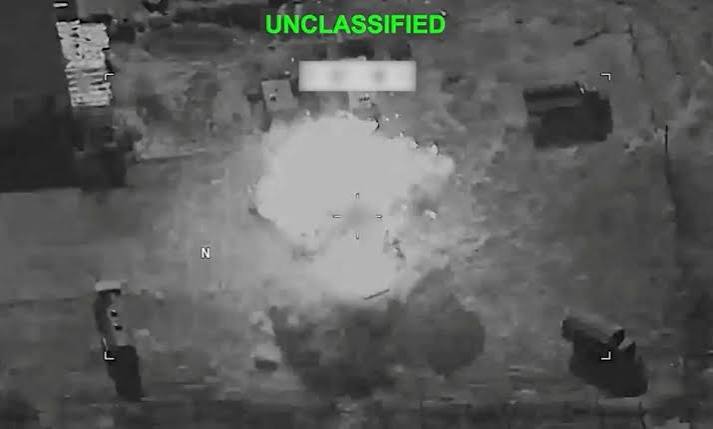
The United States military has carried out what it described as a “heavy wave of strikes” against Iran, marking a major escalation in the ongoing conflict after Tehran launched attacks targeting American positions in Jordan.
The latest exchange of fire has ended a nearly week-long lull in hostilities and deepened fears that the conflict could expand further across the Middle East. The renewed violence has also involved Iran-aligned armed groups in the region, reducing hopes for a swift return to diplomatic talks between Washington and Tehran.
US President Donald Trump had earlier warned that Iran would face a strong response following the missile attacks on US bases in Jordan. The US Central Command (CENTCOM) later confirmed that American forces had carried out a large-scale operation targeting dozens of sites linked to Iran’s Islamic Revolutionary Guard Corps (IRGC).
According to CENTCOM, the strikes hit a range of military facilities, including command and control centers, missile and drone infrastructure, coastal monitoring locations, and maritime-related assets.
Iran’s state-run IRNA news agency reported that several locations in the southwestern Khuzestan province were struck, along with areas on Qeshm Island in the Gulf. Authorities said cities including Abadan, Shadegan, Arvandkenar, and Ahvaz were among those affected.
The widening conflict has also drawn in other regional actors. Saudi Arabia and the United States carried out strikes against militant positions in Iraq, while Israel accused the Iran-backed Hezbollah group of violating a ceasefire agreement.
Saudi Arabia, the world’s largest oil exporter, said it had faced two consecutive days of drone attacks against energy facilities, blaming armed groups allied with Tehran. Jordan’s military also announced that it had intercepted five Iranian missiles after Iran’s Revolutionary Guard claimed responsibility for targeting US bases in the country.
Iran’s leadership has vowed to continue resisting what it calls foreign aggression. Iranian officials said that as long as threats against the Islamic Republic remain, their response will continue.
Meanwhile, tensions between Israel and Hezbollah have remained high. Israel accused Hezbollah of sending a drone toward an Israeli vehicle operating inside Lebanon, describing the incident as a serious breach of the existing ceasefire arrangement.
Although Israel fought alongside the United States during the early stages of the conflict with Iran and continued operations against Hezbollah in Lebanon, it has not participated in the latest US strikes against Iranian targets.
In Iraq, the joint US-Saudi military operation followed attacks on Saudi energy facilities that Riyadh blamed on Iran-linked militias. The US military said its strikes targeted weapons storage areas and logistical facilities belonging to groups aligned with Tehran.
The Hashed al-Shaabi alliance, also known as the Popular Mobilization Forces (PMF), reported that at least 20 of its members were killed in the strikes. The group condemned the operation as a dangerous escalation against what it described as an official Iraqi security organization.
Two officials from the alliance said Iranian military advisers were among those killed, with images from the aftermath showing coffins covered with Iranian flags.
The PMF was formed in 2014 during Iraq’s fight against extremist groups and was later incorporated into the country’s security structure. However, several factions within the alliance maintain close ties with Iran and have been accused of operating independently from the Iraqi government.
The latest developments highlight the growing complexity of the Middle East conflict, with multiple countries and armed groups becoming increasingly involved as tensions between the United States and Iran continue to rise.
Julian Daily Gist Editorial Team
Julian Daily Gist Editorial Team is the team responsible for researching, writing, editing, and publishing news and feature content on Julian Daily Gist. Our coverage includes Nigerian current affairs, lifestyle, entertainment, sports, health, business, and human-interest stories. We aim to provide readers with timely, accurate, and responsibly sourced information.
The Julian Daily Gist Editorial Team researches, writes, edits, and publishes news and feature content covering Nigerian current affairs, entertainment, sports, health, business, lifestyle, and human-interest stories.
We aim to provide accurate, timely, and responsibly sourced information and update our reports when credible new information becomes available.
The Julian Daily Gist Editorial Team is responsible for researching, writing, editing, and publishing content across Julian Daily Gist.
Our coverage includes Nigerian current affairs, politics, business, entertainment, sports, health, lifestyle, and human-interest stories.
We aim to provide readers with timely, accurate, useful, and responsibly sourced information. Our team makes reasonable efforts to verify important information, identify sources, distinguish allegations from confirmed facts, and update reports when credible new information becomes available.
We also believe in transparency and accountability. Readers can contact our editorial team to report factual errors, request corrections, or provide additional information relevant to a published story.
Editorial focus: News, current affairs, lifestyle, entertainment, sports, health, business, and human-interest stories.
Team BIo:
The Julian Daily Gist Editorial Team is responsible for researching, writing, editing, and publishing content across Julian Daily Gist.
Our coverage includes Nigerian current affairs, politics, business, entertainment, sports, health, lifestyle, and human-interest stories.
We aim to provide readers with timely, accurate, useful, and responsibly sourced information. Our team makes reasonable efforts to verify important information, identify sources, distinguish allegations from confirmed facts, and update reports when credible new information becomes available.
We also believe in transparency and accountability. Readers can contact our editorial team to report factual errors, request corrections, or provide additional information relevant to a published story.
Editorial focus: News, current affairs, lifestyle, entertainment, sports, health, business, and human-interest stories.
Editorial Policy:
At Julian Daily Gist, our goal is to provide readers with timely, useful, accurate, and responsibly presented news and information.
We cover Nigerian current affairs, politics, business, entertainment, sports, health, lifestyle, human-interest stories, and other topics of interest to our readers.
1. Accuracy and Verification
We make reasonable efforts to ensure that information published on Julian Daily Gist is accurate and presented in its proper context.
Before publishing a report, our editorial team makes reasonable efforts to:
- Check information against credible sources.
- Verify names, dates, locations, figures, and other important details.
- Attribute information to the appropriate source.
- Distinguish confirmed facts from allegations, claims, opinions, and speculation.
- Update stories when credible new information becomes available.
When information cannot be independently verified, we make this clear to readers rather than presenting it as established fact.
2. Sources
We use a range of sources, including:
- Official government statements.
- Police and security agencies.
- Courts and legal documents.
- Government agencies.
- Direct interviews and statements.
- Reputable news organizations.
- Publicly available records.
- Verified social media accounts and statements.
When an article relies substantially on information reported by another publication, we aim to clearly attribute the information to that source.
We do not intentionally present another publication's reporting as our own.
3. Originality
Julian Daily Gist aims to provide original editorial value.
When we report information that has already been published elsewhere, we seek to add value through original writing, context, verification, analysis, additional information, or other useful material.
We do not intentionally copy and republish articles from other websites without appropriate attribution and meaningful editorial contribution.
4. Allegations and Sensitive Claims
When reporting allegations involving individuals or organizations, we make reasonable efforts to clearly identify allegations as allegations.
We avoid presenting unproven accusations as established facts.
Where relevant, we seek or include responses from the person, organization, or representative concerned.
For criminal matters, we recognize that an allegation, arrest, charge, or accusation does not by itself establish guilt.
5. Headlines
Our headlines are intended to accurately reflect the content of our articles.
We aim to avoid deliberately misleading headlines, fabricated claims, or headlines that exaggerate facts simply to generate clicks.
6. Corrections and Updates
We take corrections seriously.
If we discover that an article contains a significant factual error, we may correct or update the article as appropriate.
Readers who identify an error are encouraged to contact us with specific information supporting the correction.
Where appropriate, significant corrections or updates may be noted within the article.
7. Editorial Independence
Editorial decisions are made independently of advertisers, sponsors, commercial partners, and other external interests.
Advertising or sponsorship does not automatically influence our editorial decisions or the opinions expressed by our writers.
8. Sponsored and Promotional Content
Where Julian Daily Gist publishes sponsored, paid, or promotional content, we aim to clearly identify it as such.
Sponsored content does not necessarily represent the independent editorial views of Julian Daily Gist.
9. Conflicts of Interest
Our editorial team should avoid situations where personal, financial, or other interests could improperly influence reporting.
Where a relevant conflict of interest exists, we aim to disclose it when appropriate.
10. Use of Images and Other Media
We aim to use images, videos, graphics, and other media responsibly and with appropriate permission, licensing, attribution, or other lawful basis where required.
We do not knowingly use copyrighted material in a manner that infringes the rights of its owner.
If you believe that material published on Julian Daily Gist infringes your copyright, please contact us so that we can review the matter.
11. Artificial Intelligence
We may use technology and artificial intelligence tools to assist with certain editorial tasks, such as research support, proofreading, formatting, transcription, or drafting assistance.
However, AI-generated information is not treated as automatically accurate. Content remains subject to human review, editing, fact-checking, and editorial judgment before publication where appropriate.
We do not intentionally publish fabricated information generated by AI.
12. Privacy and Personal Information
We take reasonable care when handling personal information and avoid publishing unnecessary private information about individuals.
Sensitive personal information is published only when there is a legitimate public-interest reason and where appropriate.
Our handling of visitor information is explained in our Privacy Policy.
13. Opinion and Commentary
Opinion articles and commentary represent the views expressed by the respective writer or contributor.
Where appropriate, opinion content will be identified as commentary, analysis, or opinion so that readers can distinguish it from straightforward news reporting.
14. User-Generated Content
Comments and other material submitted by readers may be moderated.
We reserve the right to remove content that is unlawful, defamatory, abusive, discriminatory, misleading, threatening, spam-related, or otherwise inappropriate.
User comments do not necessarily represent the views of Julian Daily Gist.
15. Our Commitment
We are committed to improving the quality, accuracy, transparency, and usefulness of Julian Daily Gist.
As our publication grows, we will continue reviewing our editorial practices and updating this policy when necessary.
16. Contact and Corrections
If you have a correction, clarification, complaint, copyright concern, or question about our editorial practices, please contact us through our Contact Us page.