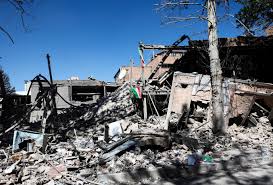
Iran and Israel traded fresh attacks on Tuesday, April 7, as Tehran refused to reopen the Strait of Hormuz or accept a ceasefire deal ahead of a deadline set by U.S. President Donald Trump, who warned of severe consequences if his demands were not met.
Despite the tensions, there were signs of potential diplomatic movement. Iran’s ambassador to Pakistan said efforts by Islamabad to mediate an end to the conflict were “approaching a critical, sensitive stage.” Iran has rejected a U.S.-backed proposal brokered by Pakistan calling for an immediate ceasefire, reopening of the strait, and broader peace talks within 15 to 20 days. Instead, Tehran submitted a 10-point plan that includes ending regional conflicts, ensuring safe passage through the strait, lifting sanctions, and rebuilding affected areas.
Trump issued stark warnings, stating that Iran could be “taken out in one night” if it failed to comply. He threatened widespread destruction of infrastructure, including power plants and bridges, if no agreement is reached by the deadline.
Fighting continued across the region. The Israeli military carried out airstrikes targeting Iranian government infrastructure in Tehran and other locations while intercepting missiles launched from Iran. Israel also warned Iranian civilians to avoid railways for safety reasons.
Saudi Arabia reported intercepting ballistic missiles aimed at its eastern region, with debris falling near energy facilities. The kingdom has faced repeated attacks involving missiles and drones since the conflict began, most of which were intercepted. Bahrain, Saudi Arabia, and the United Arab Emirates issued public safety alerts, and a key bridge linking Saudi Arabia and Bahrain was briefly closed as a precaution.
Amid questions about civilian infrastructure being targeted, Trump dismissed concerns over potential war crimes, saying he was “not at all” worried about such implications. Iran’s envoy to the United Nations condemned the threats, calling them “direct incitement to terrorism” and evidence of intent to commit war crimes. Iran’s military leadership also described Trump’s statements as unrealistic.
In a show of domestic defiance, Iran’s deputy sports minister urged citizens, including artists and athletes, to form human chains around power plants in protest against potential attacks on public infrastructure.
The Strait of Hormuz remains a major flashpoint. Iran has effectively shut down the waterway, which carries about one-fifth of the world’s oil and gas supply, pushing oil prices higher. Brent crude rose above $111 per barrel, while U.S. crude exceeded $113.
The conflict has already taken a heavy toll. Thousands have been killed across the Middle East, including over 3,500 in Iran, according to a U.S.-based rights group, and nearly 1,500 in Lebanon, where Israeli strikes have targeted Hezbollah.
Julian Daily Gist Editorial Team
Julian Daily Gist Editorial Team is the team responsible for researching, writing, editing, and publishing news and feature content on Julian Daily Gist. Our coverage includes Nigerian current affairs, lifestyle, entertainment, sports, health, business, and human-interest stories. We aim to provide readers with timely, accurate, and responsibly sourced information.
The Julian Daily Gist Editorial Team researches, writes, edits, and publishes news and feature content covering Nigerian current affairs, entertainment, sports, health, business, lifestyle, and human-interest stories.
We aim to provide accurate, timely, and responsibly sourced information and update our reports when credible new information becomes available.
The Julian Daily Gist Editorial Team is responsible for researching, writing, editing, and publishing content across Julian Daily Gist.
Our coverage includes Nigerian current affairs, politics, business, entertainment, sports, health, lifestyle, and human-interest stories.
We aim to provide readers with timely, accurate, useful, and responsibly sourced information. Our team makes reasonable efforts to verify important information, identify sources, distinguish allegations from confirmed facts, and update reports when credible new information becomes available.
We also believe in transparency and accountability. Readers can contact our editorial team to report factual errors, request corrections, or provide additional information relevant to a published story.
Editorial focus: News, current affairs, lifestyle, entertainment, sports, health, business, and human-interest stories.
Team BIo:
The Julian Daily Gist Editorial Team is responsible for researching, writing, editing, and publishing content across Julian Daily Gist.
Our coverage includes Nigerian current affairs, politics, business, entertainment, sports, health, lifestyle, and human-interest stories.
We aim to provide readers with timely, accurate, useful, and responsibly sourced information. Our team makes reasonable efforts to verify important information, identify sources, distinguish allegations from confirmed facts, and update reports when credible new information becomes available.
We also believe in transparency and accountability. Readers can contact our editorial team to report factual errors, request corrections, or provide additional information relevant to a published story.
Editorial focus: News, current affairs, lifestyle, entertainment, sports, health, business, and human-interest stories.
Editorial Policy:
At Julian Daily Gist, our goal is to provide readers with timely, useful, accurate, and responsibly presented news and information.
We cover Nigerian current affairs, politics, business, entertainment, sports, health, lifestyle, human-interest stories, and other topics of interest to our readers.
1. Accuracy and Verification
We make reasonable efforts to ensure that information published on Julian Daily Gist is accurate and presented in its proper context.
Before publishing a report, our editorial team makes reasonable efforts to:
- Check information against credible sources.
- Verify names, dates, locations, figures, and other important details.
- Attribute information to the appropriate source.
- Distinguish confirmed facts from allegations, claims, opinions, and speculation.
- Update stories when credible new information becomes available.
When information cannot be independently verified, we make this clear to readers rather than presenting it as established fact.
2. Sources
We use a range of sources, including:
- Official government statements.
- Police and security agencies.
- Courts and legal documents.
- Government agencies.
- Direct interviews and statements.
- Reputable news organizations.
- Publicly available records.
- Verified social media accounts and statements.
When an article relies substantially on information reported by another publication, we aim to clearly attribute the information to that source.
We do not intentionally present another publication's reporting as our own.
3. Originality
Julian Daily Gist aims to provide original editorial value.
When we report information that has already been published elsewhere, we seek to add value through original writing, context, verification, analysis, additional information, or other useful material.
We do not intentionally copy and republish articles from other websites without appropriate attribution and meaningful editorial contribution.
4. Allegations and Sensitive Claims
When reporting allegations involving individuals or organizations, we make reasonable efforts to clearly identify allegations as allegations.
We avoid presenting unproven accusations as established facts.
Where relevant, we seek or include responses from the person, organization, or representative concerned.
For criminal matters, we recognize that an allegation, arrest, charge, or accusation does not by itself establish guilt.
5. Headlines
Our headlines are intended to accurately reflect the content of our articles.
We aim to avoid deliberately misleading headlines, fabricated claims, or headlines that exaggerate facts simply to generate clicks.
6. Corrections and Updates
We take corrections seriously.
If we discover that an article contains a significant factual error, we may correct or update the article as appropriate.
Readers who identify an error are encouraged to contact us with specific information supporting the correction.
Where appropriate, significant corrections or updates may be noted within the article.
7. Editorial Independence
Editorial decisions are made independently of advertisers, sponsors, commercial partners, and other external interests.
Advertising or sponsorship does not automatically influence our editorial decisions or the opinions expressed by our writers.
8. Sponsored and Promotional Content
Where Julian Daily Gist publishes sponsored, paid, or promotional content, we aim to clearly identify it as such.
Sponsored content does not necessarily represent the independent editorial views of Julian Daily Gist.
9. Conflicts of Interest
Our editorial team should avoid situations where personal, financial, or other interests could improperly influence reporting.
Where a relevant conflict of interest exists, we aim to disclose it when appropriate.
10. Use of Images and Other Media
We aim to use images, videos, graphics, and other media responsibly and with appropriate permission, licensing, attribution, or other lawful basis where required.
We do not knowingly use copyrighted material in a manner that infringes the rights of its owner.
If you believe that material published on Julian Daily Gist infringes your copyright, please contact us so that we can review the matter.
11. Artificial Intelligence
We may use technology and artificial intelligence tools to assist with certain editorial tasks, such as research support, proofreading, formatting, transcription, or drafting assistance.
However, AI-generated information is not treated as automatically accurate. Content remains subject to human review, editing, fact-checking, and editorial judgment before publication where appropriate.
We do not intentionally publish fabricated information generated by AI.
12. Privacy and Personal Information
We take reasonable care when handling personal information and avoid publishing unnecessary private information about individuals.
Sensitive personal information is published only when there is a legitimate public-interest reason and where appropriate.
Our handling of visitor information is explained in our Privacy Policy.
13. Opinion and Commentary
Opinion articles and commentary represent the views expressed by the respective writer or contributor.
Where appropriate, opinion content will be identified as commentary, analysis, or opinion so that readers can distinguish it from straightforward news reporting.
14. User-Generated Content
Comments and other material submitted by readers may be moderated.
We reserve the right to remove content that is unlawful, defamatory, abusive, discriminatory, misleading, threatening, spam-related, or otherwise inappropriate.
User comments do not necessarily represent the views of Julian Daily Gist.
15. Our Commitment
We are committed to improving the quality, accuracy, transparency, and usefulness of Julian Daily Gist.
As our publication grows, we will continue reviewing our editorial practices and updating this policy when necessary.
16. Contact and Corrections
If you have a correction, clarification, complaint, copyright concern, or question about our editorial practices, please contact us through our Contact Us page.