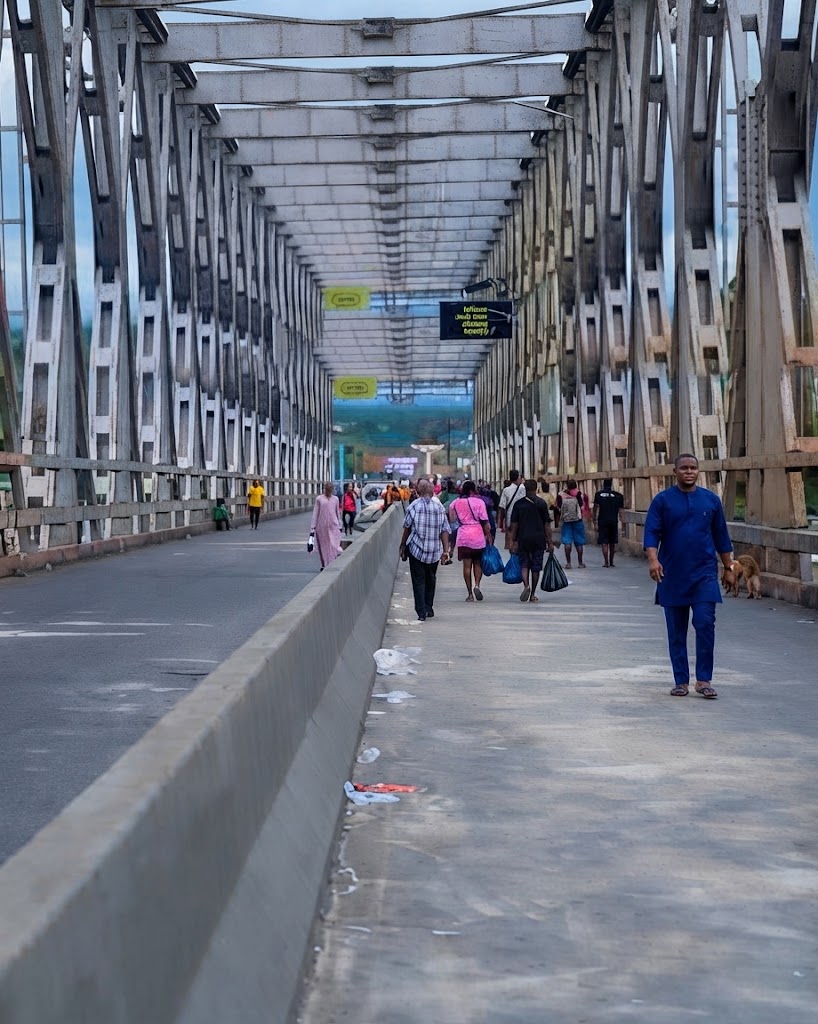
The ongoing rehabilitation of the First Niger Bridge linking Onitsha in Anambra State with Asaba in Delta State has generated a fresh conversation among motorists and commuters following the introduction of a new central demarcation on the bridge.
The Federal Government is currently carrying out rehabilitation work on the ageing bridge after structural components, including bolts, nuts and parts of the expansion-joint steelwork, were found to have been vandalised.
However, while the repair work has received attention, the new arrangement dividing the existing roadway into two distinct lanes has become another major talking point among road users.
What Is the New Demarcation About
During the ongoing rehabilitation, construction teams began installing a central divider to separate traffic travelling towards Onitsha from vehicles heading towards Asaba.
The idea is to create clearly separated traffic directions instead of allowing vehicles travelling in opposite directions to share the same undivided roadway.
According to reports, the Federal Government says the arrangement is intended to improve traffic organisation and make movement around the corridor more orderly.
The bridge was originally built with an open, single-space roadway rather than the type of modern dual carriageway motorists are accustomed to today.
Why Are Some Motorists Worried
Some motorists and residents have questioned whether dividing the existing space will make the lanes too narrow, particularly for heavy-duty vehicles.
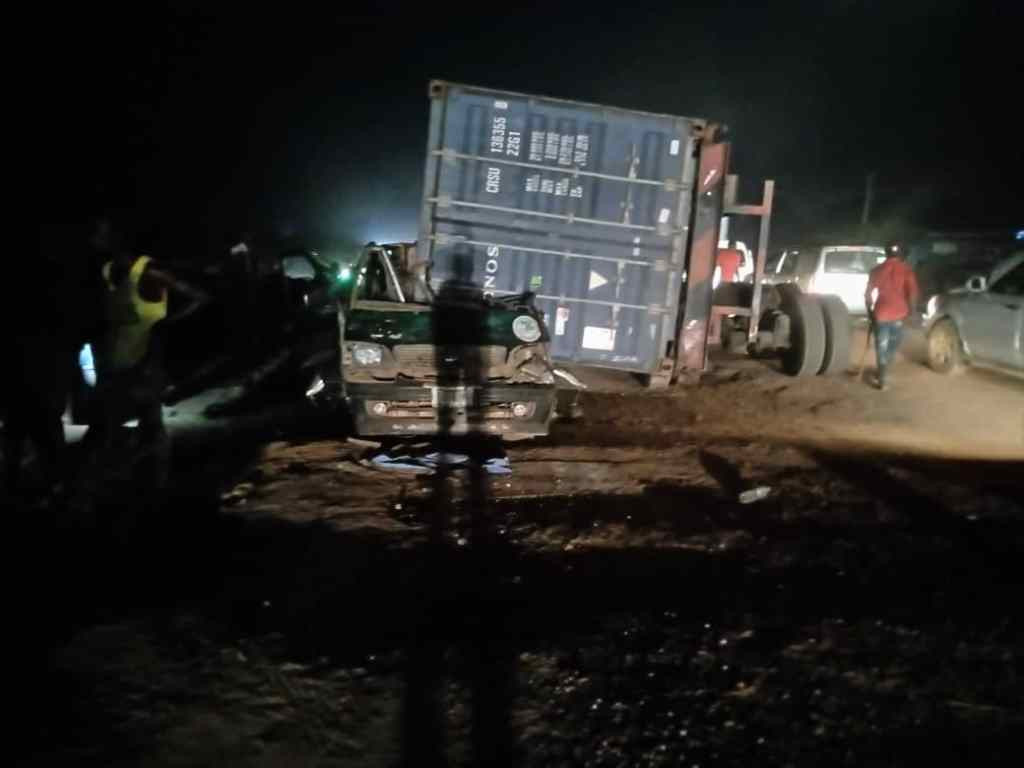
One major concern is what could happen if a truck breaks down inside one of the newly separated lanes.
Because the available space is limited, a broken-down truck could obstruct an entire direction of traffic and potentially create a long queue.
There are also concerns about what would happen during an accident, vehicle fire or another emergency.
If a vehicle becomes stranded in one lane, motorists behind it may have limited room to manoeuvre around the obstruction.
Emergency Response Is Another Concern
The concerns are not coming only from ordinary motorists.
Before the demarcation was implemented, the Federal Road Safety Corps (FRSC) called for stronger emergency-response and traffic-management arrangements around the bridge.
The FRSC said it was engaging with the Federal Ministry of Works over potential safety and traffic-management challenges.
One of the concerns highlighted by the Corps was the difficulty emergency responders and towing vehicles could face if a vehicle breaks down or a crash occurs on the bridge.
The FRSC specifically noted that some of its recovery equipment can weigh as much as 70 tonnes and therefore requires sufficient space to manoeuvre.
Some Road Users Support the Demarcation
Not everyone is against the new arrangement.
Some motorists believe separating traffic moving in opposite directions could bring better organisation to the bridge.
With vehicles heading towards Onitsha kept apart from those travelling towards Asaba, supporters argue that traffic could become more orderly and predictable.
A commercial shuttle operator quoted by Punch said she believed the double-lane arrangement could organise traffic better and bring long-term order to movement across the bridge.
The Main Question: What Happens When a Truck Breaks Down
This is one of the biggest questions being raised by critics of the arrangement.
The First Niger Bridge carries significant traffic, including commercial vehicles and heavy trucks.
If a large truck becomes disabled in one of the narrow lanes, motorists may have little room to pass.
In a situation involving a crash or fire, the problem could become more serious because emergency responders may need enough space to reach the affected vehicle.
This is why some road users are asking whether dedicated towing or emergency-response vehicles should be stationed at both ends of the bridge.
Does the Demarcation Make the Bridge Safer
That question cannot simply be answered by looking at the divider alone.
The overall safety of the arrangement depends on several factors, including the bridge’s structural condition, lane width, traffic volume, emergency access, towing arrangements and how motorists use the lanes.
The Federal Government has said the bridge will not be reopened until major structural rehabilitation is completed.
Works Minister David Umahi also directed further assessment of structural components above and below the water level as part of the rehabilitation process.
Therefore, the demarcation should be considered alongside the wider rehabilitation and traffic-management plans rather than as a standalone change.
What Happens If There Is an Accident
This remains one of the biggest concerns being discussed by road users.
On an undivided roadway, motorists may sometimes have more room to manoeuvre around an obstruction, depending on the circumstances.
With a physical divider separating opposing traffic, however, movement around an obstruction may become more restricted.
That is why emergency access and rapid removal of broken-down vehicles will be particularly important if the new arrangement is maintained.
Government Still Working on the Bridge
The controversy over the demarcation comes while the Federal Government continues its wider rehabilitation programme.
The bridge was temporarily closed to traffic in September to allow emergency repair work.
The closure was initially expected to last until September 21 but was extended after rainfall and additional rehabilitation requirements affected the timeline.
The government has also directed other improvements around the bridge, including additional structural assessment and infrastructure upgrades.
What Motorists Want
For many road users, the issue is not necessarily opposition to improving the bridge.
Instead, they want assurances that the new arrangement will not create a bigger problem when there is a truck breakdown, accident or emergency.
Some motorists are calling for towing vehicles and emergency-response teams to be readily available at both ends of the bridge.
That way, a broken-down vehicle could be removed quickly before it causes a major traffic build-up.
The new demarcation on the First Niger Bridge has generated mixed reactions.
While some road users believe separating traffic will improve order and reduce the possibility of vehicles travelling against each other, others are concerned that the narrower lanes could create difficulties for trucks and emergency responders.
The FRSC has already highlighted the importance of emergency access and effective traffic management.
As rehabilitation continues, the effectiveness of the new arrangement will ultimately depend not only on the physical divider but also on how traffic is managed and how quickly accidents or vehicle breakdowns are handled.
For now, motorists and commuters will be watching closely as work continues on one of the most important links between the South-East and South-South regions.
Juliandailygist will continue to monitor developments surrounding the First Niger